
How to Plan a Personalized Gift Box
Plan a personalized gift box in dependency order: define the recipient and occasion, set the total budget, deadline, and practical constraints, then choose the theme → contents → personalization → box size. Before assembly, review the choices together; if a later conflict appears, revise the earliest affected decision and re-check the decisions that follow.
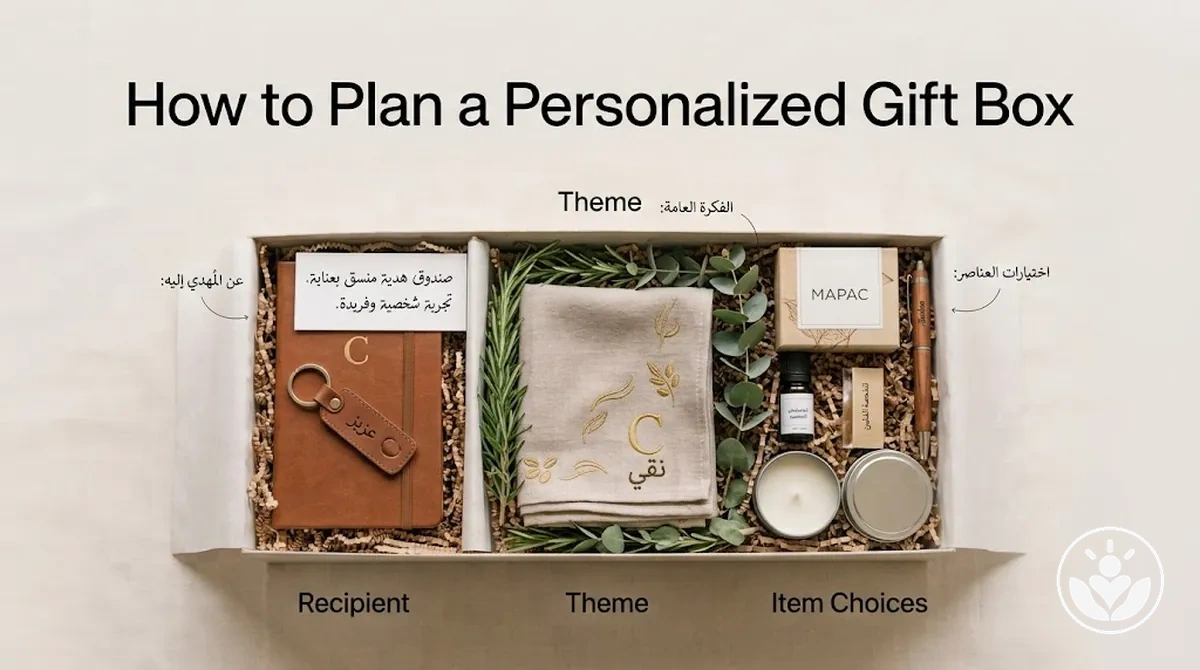
Personalized gift box planning map
Each stage narrows the next one. The method stays the same even when the recipient, occasion, budget, deadline, or available options change.
- Define the brief Use the recipient, relationship, occasion, known preferences, dislikes, restrictions, and intended tone to define what is suitable.
- Set feasibility limits Set a total budget and deadline, then account for sourcing, personalization, assembly, availability, delivery, and physical limits.
- Build in dependency order Theme → contents → personalization → final box size. Each choice should remain compatible with the inputs already fixed.
- Review before assembly Check recipient fit, occasion fit, budget, timing, theme consistency, content suitability, personalization, box-size feasibility, and logistics.
Conflict rule: change the earliest decision that no longer fits the known conditions, then verify every dependent choice after it.
The sections below turn that sequence into practical filters and pass-or-revise checks without assuming one universal item count, budget, or theme.
Table of Contents
Define the Recipient, Occasion, and Relevant Preferences
The recipient and occasion establish the suitability criteria for the personalized gift box. Use known recipient information—not broad demographic assumptions—to decide which themes, items, and personalization choices are appropriate.
Separate recipient information, occasion requirements, and practical restrictions before choosing a theme or contents. Each known condition should function as a filter with a clear planning implication.

Recipient and occasion filters
- Relationship
- The recipient's relationship to the giver affects the level of familiarity that may be appropriate; a close personal relationship can support more personal choices, while a professional relationship may call for greater restraint.
- Interests
- Known interests can support choices that reflect what the recipient actually enjoys; inferred interests should remain tentative until there is a reliable preference signal.
- Dislikes
- A known dislike can rule out related choices even when they otherwise fit the occasion or intended purpose.
- Preferences
- Stated recipient preferences provide a stronger basis for suitability than assumptions based on age, gender, or other broad demographic labels.
- Occasion and purpose
- The gifting occasion helps determine what the gift box is meant to communicate, such as celebration, appreciation, recognition, or support.
- Tone
- The occasion and relationship can affect whether personalization should feel informal, warm, restrained, or formal; use the tone supported by the actual context rather than assuming it from the occasion alone.
- Practical restrictions
- Known restrictions limit the set of suitable choices; for example, dietary restrictions or allergies can rule out particular edible items.
For the same occasion, different recipients can require different choices because their preferences, relationship to the giver, restrictions, or desired tone differ. These criteria are therefore filters for later decisions, not a fixed formula.
Set the Budget, Timing, and Practical Constraints
Gift-box planning constraints define what can realistically be completed before detailed selection begins. The total budget should cover the relevant cost of the finished gift box—not only its contents—including the box, packaging materials, personalization, and delivery when those costs apply.
Timing is feasible only when required sourcing and personalization lead times, assembly time, and delivery or handover can fit before the deadline. Availability, logistics, and physical constraints can narrow the feasible scope even when the budget itself allows a choice.

Feasibility constraints
- Total budget
- Set a spending limit that covers the relevant parts of the finished gift box, not only the items placed inside it; where applicable, the box, packaging materials, personalization, and delivery also use part of that limit.
- Item cost
- The amount committed to individual items affects how much of the total budget remains for the other required parts of the plan, so item choices may need to be narrowed when those additional costs apply.
- Deadline and lead time
- The completion date limits how much sourcing time is available; items or personalization requiring a longer lead time may need to be simplified or excluded when they cannot fit the deadline.
- Assembly time
- The plan needs enough time between receiving the required elements and the shipping or handover deadline to assemble the gift box.
- Availability
- If a planned item or personalization option is unavailable within the required timeframe, the scope may need to change rather than delaying the whole plan.
- Delivery and logistics
- The delivery method and handover requirements affect timing and practical feasibility, especially when transport must occur before a fixed occasion or deadline.
- Physical constraints
- Limits associated with the box, transport, storage, or handover can restrict the size, quantity, or form of later choices even when budget and timing allow them.
If the deadline is fixed and a planned element cannot be sourced, personalized, assembled, or delivered in time, that element is outside the feasible scope and should be replaced, simplified, or removed. A tighter budget creates the same kind of scope decision: it narrows later choices without prescribing one universal combination of contents, packaging, or personalization.
Make the Core Planning Decisions in the Right Order
The default decision order is theme → contents → personalization → final box size. This order follows the dependency between decisions: the theme frames selection, the contents determine what must fit, and personalization can add space, timing, or format requirements before the final container is confirmed.
Recipient, occasion, budget, timing, availability, and other practical constraints are already-established inputs. Each later checkpoint should use those inputs rather than reopening the plan from scratch.

How the core sequence works
- Choose the theme direction Define the overall direction using the established planning inputs, then check that it remains compatible with the recipient, occasion, budget, timing, and constraints before continuing.
- Define the contents Select the intended contents within that direction, then check that the choices remain feasible under the established constraints without assuming an exact item count.
- Confirm personalization Decide which planned elements, if any, will be personalized, then check that those decisions still fit the contents, timing, and other relevant constraints.
- Confirm the final box size Confirm the box size after the intended contents and relevant personalization requirements are known, then verify that the planned elements can be accommodated within the applicable physical constraints.
If a later constraint exposes a conflict, revisit the earliest affected decision and then re-check the dependent decisions that follow it.
Choose a Theme Before Finalizing the Contents
A gift box theme should act as a selection filter, not merely as a decorative label. It narrows candidate items by defining what supports the intended experience and what conflicts with it.
Theme fit still depends on recipient preferences, the occasion, intended tone, budget, and availability. A candidate item is consistent with the theme only when it supports the concept without conflicting with those established inputs.

- Recipient relevance: Include a candidate item when it fits known recipient preferences; rule it out when it conflicts with a known preference or dislike.
- Occasion and tone: Include an item when it supports the intended occasion and tone; exclude it when its meaning or character conflicts with that context.
- Budget: Keep an otherwise suitable item eligible only when it fits within the established budget alongside the other planned requirements.
- Availability: Keep an item in consideration when it is available within the required planning timeframe; otherwise, the theme may need another candidate that serves a similar role.
For example, a broad relaxation theme could include an item connected to a recipient's known calming routine while ruling out an unrelated novelty item chosen only for variety. Detailed theme development belongs in the separate guidance on how to choose a suitable theme.
Decide What to Include Before Refining the Item Mix
Define the eligible gift box contents before refining how the final combination works together. Start with the roles the box needs and the candidate item categories that could serve those roles.
A candidate becomes eligible when it meets the relevant filters for recipient relevance, theme fit, practical suitability, budget share, and purpose. Balance, redundancy, and cohesion belong to the later curation stage, so there is no universal item count to impose at this step.

- Recipient relevance: A candidate qualifies when its role fits a known recipient preference or need; remove or defer it when that relevance is absent or conflicts with known preferences.
- Theme fit: Keep an item eligible when it supports the established theme direction; defer it when it conflicts with that direction.
- Practical suitability: A candidate remains eligible when its size, handling needs, availability, and other relevant constraints fit the plan; rule it out when a known practical constraint makes it unsuitable.
- Budget share: Keep a candidate in scope when its cost leaves sufficient budget for the other required parts of the planned box; defer it when its budget share would conflict with those established requirements.
- Purpose: Each eligible item should serve a clear role in the contents; remove or defer a candidate when it adds no distinct purpose or unnecessarily duplicates a role already covered.
If two candidates serve the same purpose and one has weaker recipient relevance, that candidate can be removed or deferred rather than retained only to add another item category. The separate guide on how to decide what to include covers content selection in more detail.
Decide How the Gift Box Will Be Personalized
Gift box personalization should reflect the recipient and occasion while remaining feasible within the available time, space, and budget. The form and degree of personalization should fit the intended tone rather than being added simply because another personalized detail is possible.

A personal note, name, initials, custom message, or recipient-specific item can personalize the box. Choose among these forms by checking recipient relevance, tone, lead time, permanence, available space, and budget before committing to the choice.
- Recipient and tone: Use a personalized detail when its wording, form, and degree fit the recipient and the tone of the occasion; defer it when those signals conflict.
- Personal note or custom message: Keep the message concise enough for the available space and appropriate to the relationship and occasion.
- Name or initials: Choose an identifying detail when the recipient information is confirmed and its level of permanence is suitable for the planned use.
- Recipient-specific items: Treat an item choice as personalization when it reflects a known recipient preference rather than an assumed preference.
- Lead time, space, and budget: Keep a personalization option in scope when its required lead time, available space, and budget implication remain compatible with the established plan.
A personal note or custom message can suit a context where written wording is appropriate, while a name or initials may fit when a more permanent identifying detail is suitable. Meaningful personalization increases recipient relevance; mismatched personalization only adds complexity.
Confirm the Box Size After the Contents Are Known
Box size is a dependency decision, and the direction of that dependency changes according to whether the container is flexible or already fixed.
Which decision controls the fit?
Flexible container
Contents determine box size. Use item dimensions, fragility, stacking limits, and cushioning needs to determine the required internal space and capacity. The internal dimensions should fit the contents and protective material without relying on impractical empty space.
Fixed container
Box dimensions constrain the contents. The available internal space may require changes to item choice, stacking assumptions, cushioning, or the usable amount of contents. Items that cannot be accommodated should not be forced into the planned mix.
Once this dependency is clear, detailed measuring and fit decisions belong in the guidance on how to select the right gift box size.
Review the Gift Box Plan Before Assembly
Review the gift box plan for internal consistency before assembly. The plan passes only when recipient fit, occasion fit, budget, timing, theme consistency, content suitability, personalization, box-size feasibility, and logistics remain compatible.
Use each criterion as a pass-or-revise condition. A conflict means the decision that created it needs revision; for example, an item that exceeds the available box capacity or budget requires a change to the item, box-size decision, or budget allocation rather than an unrelated part of the plan.
Final pass-or-revise check
- Recipient fit: Pass when the planned choices remain consistent with known recipient preferences or needs; revise the affected choice when a known preference, dislike, or restriction conflicts with it.
- Occasion fit: Pass when the plan remains appropriate to the occasion and intended tone; revise the conflicting theme, content, or personalization decision when it does not.
- Budget: Pass when the planned costs remain within the established budget; revise the cost-driving choice or budget allocation when they exceed it.
- Timing: Pass when sourcing, personalization, and other required lead times remain compatible with the established deadline; revise the affected choice when it cannot be completed in time.
- Theme consistency: Pass when the planned contents support the established theme direction; revise or defer a conflicting item when they do not.
- Content suitability: Pass when each planned item remains relevant, feasible, and purposeful within the box; revise or defer an item that conflicts with those requirements.
- Personalization: Pass when the planned personalization remains appropriate for the recipient and occasion and feasible within the established constraints; revise the personalization choice when it conflicts with them.
- Box-size feasibility: Pass when the box capacity and internal dimensions can accommodate the planned contents and relevant cushioning needs; revise the box-size decision or incompatible contents when they cannot.
- Logistics: Pass when required materials, availability, delivery, and handover conditions remain compatible with the plan; revise the affected sourcing or logistics decision when a known requirement cannot be met.
Once content compatibility has been checked, the separate guidance on how to curate items that work together covers detailed item-mix refinement.
Common Personalized Gift Box Planning Mistakes
A personalized gift box planning mistake is a decision that creates avoidable rework, recipient mismatch, overspending, deadline pressure, or a conflict between later choices. The practical correction is to trace the problem back to the earliest decision that no longer fits the known conditions.
- Choosing for the giver instead of the recipient: This planning error may weaken recipient fit when choices reflect the giver's preferences more than known recipient preferences. A recognition cue is that the reason for including an item, theme, or personalized detail depends mainly on what the giver likes. Correct it by reassessing the affected choice against reliable recipient information.
- Ignoring the occasion: A choice may create a mismatch when its tone, theme, contents, or personalization conflicts with the purpose of the occasion. The cue is a planned element that would feel suitable in another context but does not support the current occasion. Correct it by revisiting the specific choice that creates the inconsistency.
- Committing to box size without accounting for the contents: Choosing a flexible container too early can create rework if the item dimensions, fragility, cushioning needs, or stacking limits later exceed its capacity or leave impractical empty space. The cue is that the planned contents cannot be accommodated as intended. Correct it by revising the box size after the contents are known; when the container is fixed, treat its internal dimensions as a constraint that must shape item choice instead.
- Underestimating packaging or delivery costs: Focusing only on item costs may lead to overspending when packaging materials or delivery costs also use part of the established budget. The cue is that the combined planned costs exceed the budget once those requirements are included. Correct it by revising the cost-driving choices or budget allocation before committing further.
- Leaving timing too late: Delayed decisions may create deadline pressure when sourcing, personalization, or delivery requires more lead time than remains available. The cue is a planned element that cannot be completed or delivered within the required timing. Correct it by changing the affected option, simplifying the plan, or adjusting another timing-dependent decision where the deadline itself cannot move.
- Letting the theme conflict with practical constraints: A theme can create unnecessary rework when it pushes candidate choices beyond the available budget, timing, availability, or physical constraints. The cue is that maintaining the theme requires an otherwise unsuitable choice. Correct it by narrowing or revising the theme direction rather than forcing incompatible contents.
- Adding personalization that conflicts with the plan: Personalization may create mismatch or delay when its tone, permanence, space requirement, lead time, or budget implication does not fit the recipient or established constraints. The cue is that the personalized detail requires an exception to a known condition. Correct it by reducing, changing, or deferring that personalization choice.
Rechecking recipient fit, occasion, budget, timing, container constraints, theme, and personalization at the point of conflict can reduce avoidable rework. Resolve known conflicts before assembly rather than carrying them into implementation.