
Personalized Gift Boxes: How Personalization, Planning and Assembly Work
A personalized gift box is built around a specific recipient and purpose. Start with the recipient's preferences and occasion, then align the theme, contents, message, box fit and presentation; assembly should secure and present those choices without letting decoration replace recipient relevance.
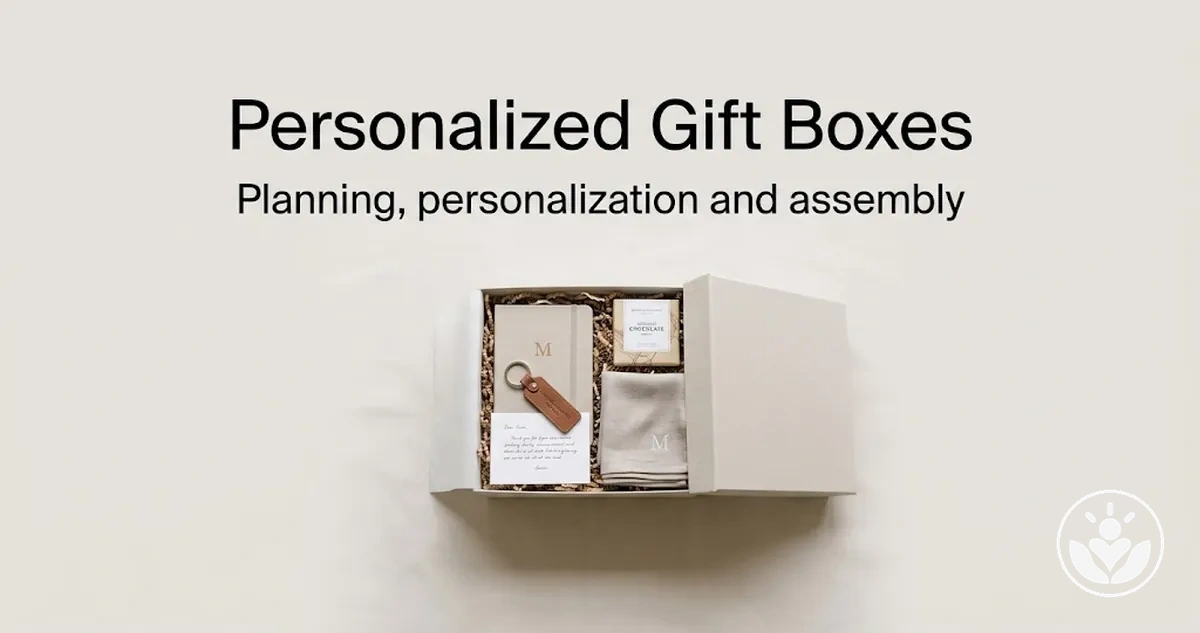
Personalized gift box decision path
Use this article-wide sequence to keep each later choice connected to the recipient, purpose and physical fit of the gift.
- Recipient + purposeDefine who the gift is for, why it is being given and what level of familiarity is appropriate.
- Theme + contentsChoose useful or meaningful items and a theme that supports, rather than overrides, recipient relevance.
- Box + fitMatch internal space, structure and protection to item quantity, dimensions, fragility and arrangement.
- Message + detailsUse accurate names or initials and wording that fits the relationship and occasion.
- Assembly + reviewArrange, support, close and reopen the box, then correct any mismatch in fit, visibility or coherence.
Decision rule: if a later choice conflicts with recipient relevance or physical fit, revise the choice instead of forcing extra items or decorative details into the box.
The sections below explain what counts as meaningful personalization, how the component choices relate to one another, and what to check before the gift box is finished.
Table of Contents
What Makes a Gift Box Personalized
A personalized gift box is a gift box whose selections or presentation are deliberately adapted to a particular recipient, relationship, occasion, or message.
Key distinction
The contents, message, theme or presentation connect known recipient details with the intended purpose of the gift.
A name, initials or decorative styling do not establish meaningful personalization when they have no relevant connection to the recipient.
The visible details below illustrate how a message, coordinated contents and presentation can signal that recipient-specific connection.
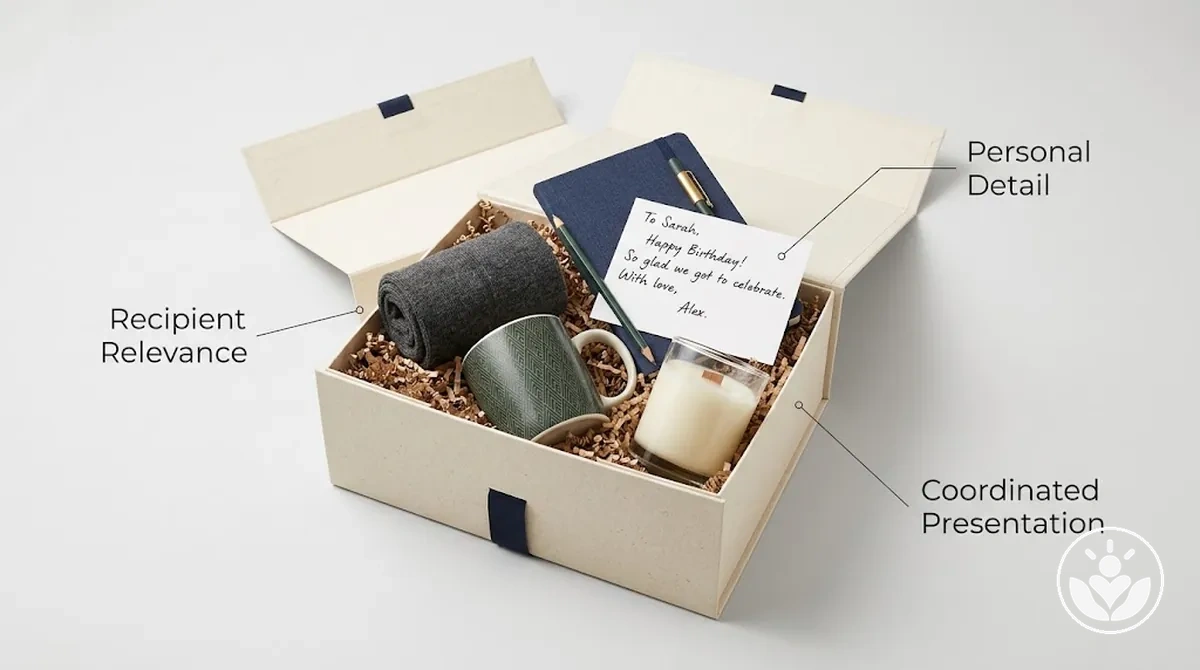
For example, a generic box may contain the same contents for any occasion, while a recipient-specific gift box can adapt its message, gift items and theme to one person's interests or relationship.
How Personalized, Custom and Curated Gift Boxes Differ
Personalized, custom, and curated gift boxes can overlap, but each label typically emphasizes a different basis for selection.
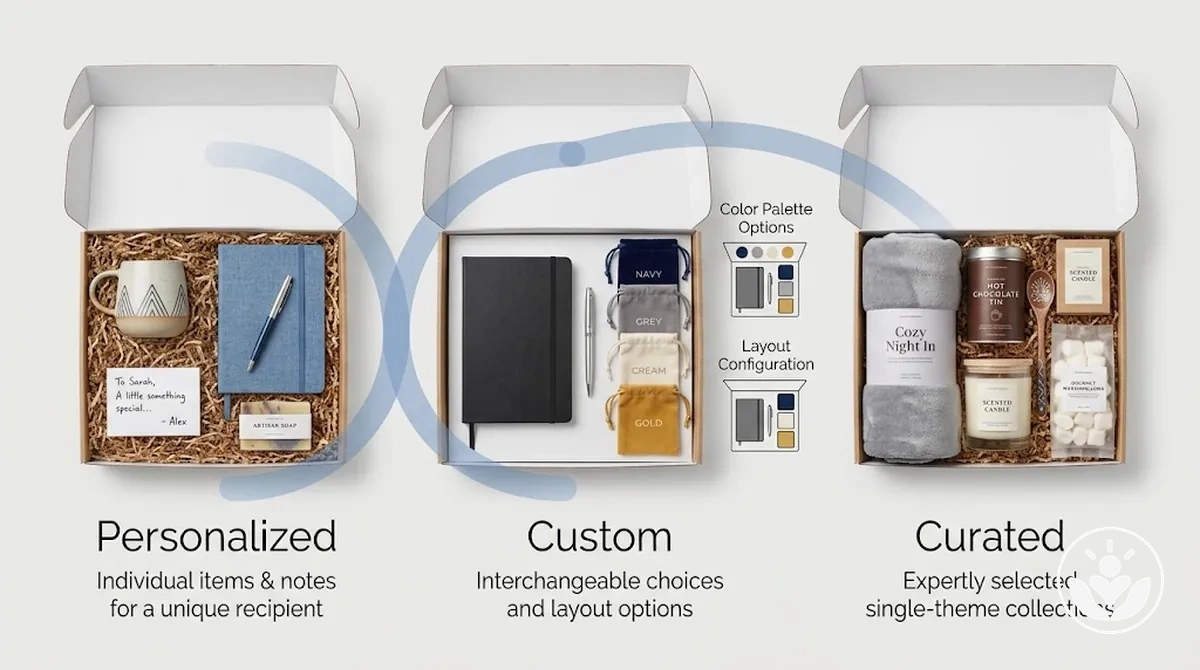
The comparison below distinguishes recipient-specific adaptation, configured choices, and a selected set organized around a theme or purpose.
| Term | Primary basis | Who shapes the selection | Typical recipient adaptation | Overlap note |
|---|---|---|---|---|
| Personalized | Recipient-specific adaptation | Giver, maker, or service using recipient details | Contents, message, or presentation reflect the recipient | Can also be custom or curated |
| Custom | Configured or specially made choices | User and/or maker through selected options | May reflect the recipient when configuration uses personal details | Can also be personalized or curated |
| Curated | Selected set around a theme or purpose | Curator, giver, or service selecting related items | May become recipient-specific when selections or messages are adapted | Can also be personalized or custom |
The visual example below shows these labels as overlapping emphases rather than mutually exclusive categories.
A curated gift box organized around a theme can also be personalized when its contents or message are adapted to one recipient.
Personalized typically emphasizes recipient adaptation, custom emphasizes configured or specially made choices, and curated emphasizes deliberate selection around a theme or purpose.
Because these characteristics can overlap, one gift box can fit more than one label.
Core Elements of a Personalized Gift Box
A personalized gift box is built from connected component groups rather than isolated decorative parts.
Box and packaging, gift items and theme, and recipient-specific details each contribute a distinct function to the finished presentation.
These components work together to support fit, relevance, and presentation, while their exact form can vary with the recipient and purpose.
The diagram shows how the major component groups form one coordinated whole.
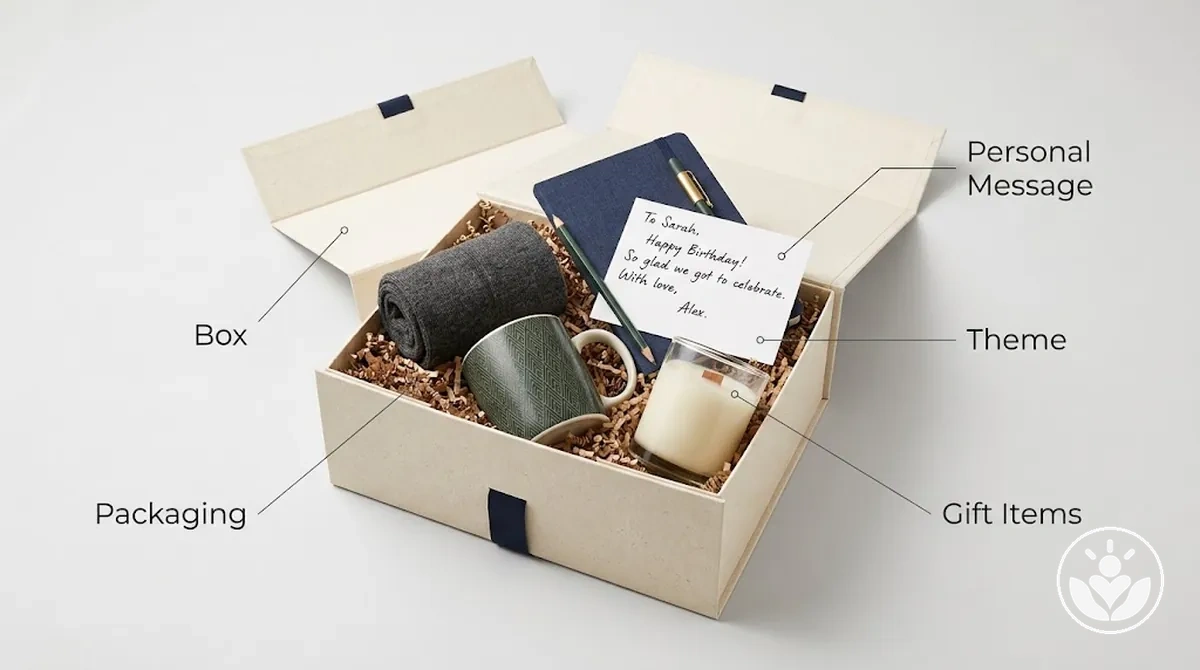
- Box and packaging: The container holds the contents, while packaging supports appropriate fit, protection, and an orderly presentation.
- Gift items and theme: The selected gift items provide the contents, while the theme helps connect compatible choices to the recipient and purpose.
- Message and recipient-specific details: A message or personal detail carries recipient-specific meaning and strengthens the relevance of the overall presentation.
For example, changing the gift items without considering the established theme can reduce the connection between the contents and presentation.
Coherence depends on how the component groups work together rather than on any single part.
Specific choices within the box and packaging depend on the intended contents and presentation; detailed gift box packaging types and materials belong to the more focused packaging context.
Box and Packaging
The box and packaging form both the functional container and the presentation structure for the chosen contents.
What changes the box choice
- Fit
- Internal space should accommodate item quantity, dimensions and arrangement without unnecessary crowding or movement.
- Protection
- Support should match item fragility and movement risk; more delicate contents may need stronger restraint than robust items.
- Structure
- The box must be able to hold the planned contents and close without compressing or destabilising them.
- Opening and presentation
- The opening style should suit the intended reveal and allow the arrangement to be closed and reopened without unnecessary disruption.
The image illustrates how fit, clearance and protective packaging relate to differently sized items inside one box.
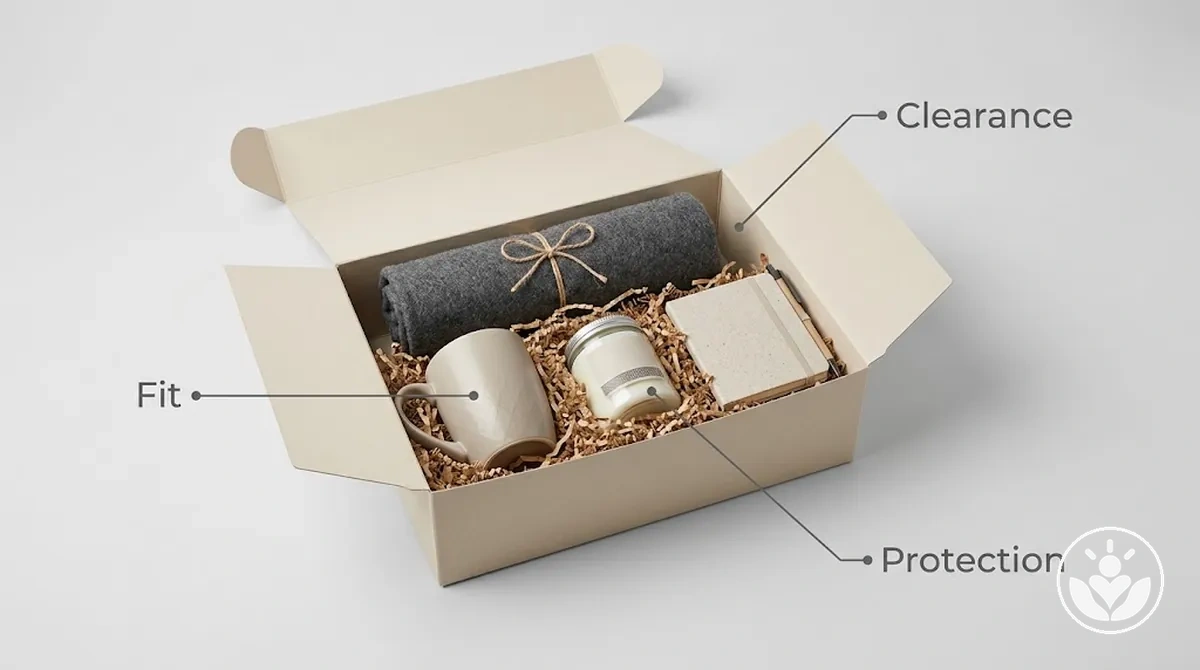
An attractive box may still be unsuitable when its internal space does not match the size, support needs or arrangement of the contents.
To assess dimensions in more detail, choose the right gift box size according to the items the box needs to hold.
Gift Items and Theme
Gift items provide the useful or meaningful contents of the box, while the theme provides a selection and presentation direction that helps those items feel connected.
Selection criteria
- Recipient relevance
- Choose items connected to known interests, needs, the relationship or the purpose of the gift rather than adding generic filler solely to increase quantity.
- Item compatibility
- Check that the item mix can coexist in the box in terms of size, fragility, handling and the intended presentation.
- Theme function
- Use the theme as a filter that coordinates compatible choices; do not let a visual theme justify items that have little recipient relevance.
- Quantity
- Use a quantity that suits the purpose and available box space. Adding more items does not automatically make the gift more personalized.
Priority rule: when a meaningful recipient-specific item conflicts with a purely decorative theme, adapt the theme or presentation before sacrificing recipient relevance.
A coherent item set therefore balances relevance, compatibility and fit. The contents should make sense for the recipient and also work together physically and visually inside the chosen box.
Personal Message and Recipient-Specific Details
A personal message and recipient-specific details signal that a gift box was prepared with a particular recipient or relationship in mind.
A handwritten note, name, initials, photo or meaningful colour choice can add personal context when the detail is accurate and appropriate for the recipient and occasion.
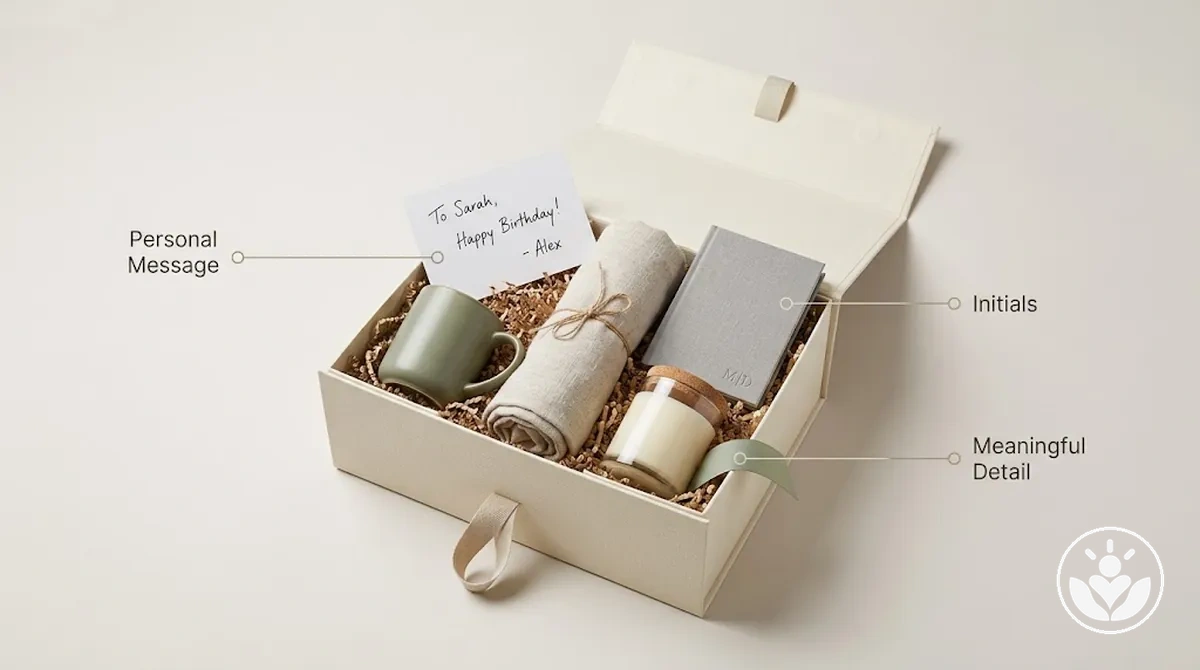
Accuracy and appropriateness check
- Verify identity details: confirm names and initials before they are printed, written or attached to the gift.
- Match the relationship: message wording, photos and sentimental details should suit the level of familiarity and the occasion.
- Prefer relevance over quantity: a few accurate, meaningful details are more useful than many generic or excessive personal touches.
More personalization does not necessarily create more relevance; appropriateness and correctness matter more than the number of personal details.
How a Personalized Gift Box Comes Together
The personalized gift box process works as a dependency chain: the recipient and purpose guide planning, which shapes later choices and assembly.
Planning constrains the theme and contents, while the selected contents determine box fit, arrangement, and finishing needs.
- Establish the recipient and purpose: These provide the context that guides the rest of the process.
- Plan the gift: Planning turns that context into practical constraints for the theme, contents, message, and presentation.
- Choose the theme and contents: These choices should follow the plan and remain relevant to the recipient and purpose.
- Determine box fit and arrangement: The selected contents determine the space, support, and arrangement the box needs.
- Complete the finishing and review: Finishing follows the assembled arrangement, while a final review checks that the choices remain coherent.
The sequence is flexible where dependencies permit, so earlier choices can be revisited when later decisions reveal a mismatch.
What matters is keeping connected decisions aligned rather than treating the workflow as one fixed sequence.
Planning Around the Recipient and Purpose
Personalized gift box planning begins by defining the recipient, purpose, and constraints before selecting or assembling the contents.
These decision inputs connect recipient preferences, relationship, and occasion with practicality and a preliminary theme direction.
- Identify recipient preferences: Use known interests and preferences to guide the preliminary direction for suitable contents.
- Define the relationship: Use the relationship to judge which message, personal details, and level of familiarity may be appropriate.
- Clarify the occasion and purpose: Use why the gift is being given to refine the theme direction and overall presentation.
- Check practical constraints: Consider constraints that affect practicality, such as what can reasonably fit, travel, delivery, or handling needs.
- Set a preliminary direction: Use the combined inputs to guide the theme and contents before detailed selection and assembly.
The same occasion can lead to different choices when recipient preferences or relationships differ, so verify that the preliminary theme and contents fit both the recipient and practical constraints.
A more detailed process to plan a personalized gift box can develop these inputs further without moving this overview into item selection or assembly.
Personalizing the Theme, Contents and Message
Personalization translates recipient information into a coordinated theme, contents and message rather than treating each element independently.
How recipient context changes each element
- Theme
- Reflect the occasion or an appropriate recipient interest without making visual styling more important than the recipient.
- Contents
- Select items for usefulness, meaning or compatibility within that recipient-led direction.
- Message
- Use wording that is specific enough to feel intentional while remaining suitable for the relationship and occasion.
- Consistency
- Check that theme, contents and message reinforce the same purpose instead of communicating unrelated ideas.
Practical distinction: superficial personalization adds visible personal touches; recipient-led personalization connects each major choice to information that actually matters for the person and purpose.
When deeper theme decisions are needed, choose a gift box theme by keeping that recipient context central; alignment among the three choices matters more than the quantity of customization.
Assembling and Finishing the Gift Box
Gift box assembly combines the planned components so the contents remain stable, visible, accessible, and coherent with the intended presentation.
Box preparation, item placement, support, and finishing work as dependent stages, with adjustments based on fit, item size, and fragility.
- Prepare the box: Check the available space and contents so the planned arrangement suits the box.
- Position the focal item: Place the larger or focal item where its height and visibility support the intended presentation.
- Arrange the remaining contents: Position smaller items around the focal item while keeping them visible and accessible.
- Support items where needed: Adjust support according to fragility, movement, and empty space without unnecessarily crowding the contents.
- Add restrained finishing: Use finishing details that complement the arrangement without obscuring or destabilizing the gift items.
- Verify the finished box: Check movement, closure, reopening, visibility, and presentation, then adjust the arrangement where needed.
Box shape and item mix can require different placement decisions, so verify that the contents remain coherent and secure when handled, closed, and reopened.
More detailed guidance on how to arrange items in a gift box can develop the placement stage while keeping this sequence focused on assembly and finishing.
Principles for a Coherent Personalized Gift Box
A coherent personalized gift box depends first on recipient relevance, then on purposeful selection, proportional fit, and presentation choices that support the same purpose.
Visual consistency and the personalization level can strengthen coherence, but they should not override the recipient's interests, needs, or intended meaning.
The criteria below connect recipient-and-purpose decisions with presentation-and-fit conditions, showing what to check and how a weak condition may affect the finished box.
| Criterion | Condition to check | Why it matters | If weak |
|---|---|---|---|
| Recipient relevance | Contents, message, and details reflect the recipient's interests, relationship, or purpose. | Supports personal meaning and appropriateness. | The box may feel generic or mismatched despite attractive presentation. |
| Purposeful selection | Selected items have a useful, meaningful, or compatible role within the gift. | Supports usability and balance rather than unrelated accumulation. | The contents may feel disconnected from one another or the intended purpose. |
| Visual consistency | Colours, arrangement, and finishing support the recipient context without dominating it. | Helps the presentation appear coordinated while preserving recipient relevance. | Conflicting presentation choices may weaken visual coherence. |
| Proportional fit | Item sizes and arrangement suit the available box space and remain visually balanced. | Supports usability, visibility, balance, and presentation. | Crowding or excessive empty space may make the arrangement feel poorly resolved. |
| Appropriate personalization level | The personalization level and personal details suit the recipient, relationship, and occasion. | Keeps the message and details relevant without relying on quantity of customization. | Personal touches may feel excessive, generic, or inappropriate for the context. |
For example, a visually attractive box can still feel incoherent when its polished colour scheme surrounds gift contents or a message that does not fit the recipient.
The relative weight of each criterion can vary with the recipient and purpose, but visual polish cannot substitute for recipient relevance.
Once these coherence criteria are satisfied, more detailed choices can improve gift box presentation without making aesthetic polish the definition of personalization.
Common Personalized Gift Box Mistakes
Personalized gift box mistakes usually weaken recipient relevance, physical fit, coherence, or presentation rather than affecting every part of the gift equally.
Common errors include ignoring recipient preferences, using an incorrect name or unsuitable wording, choosing the wrong box size, creating clutter, and overlooking practical constraints.
The table connects each mistake with its likely consequence, a recognition cue, and a concise correction so the underlying mismatch can be addressed without repeating the full planning or assembly process.
| Mistake | Likely consequence | Recognition cue | Corrective direction |
|---|---|---|---|
| Choosing around giver preferences instead of recipient preferences | The contents may feel generic or personally irrelevant. | Choices mainly reflect what the giver likes rather than known recipient interests. | Correct by checking each major choice against the recipient's interests and the gift's purpose. |
| Using an incorrect name or unsuitable wording | The personal detail can undermine the intended sense of care or relevance. | A name is misspelled, or the wording does not suit the recipient, relationship, or occasion. | Correct by verifying names and reviewing wording for accuracy and appropriateness before finishing the box. |
| Choosing a mismatched box size | The contents may appear cramped, excessively spaced, or difficult to arrange securely. | Items crowd one another, leave disruptive empty space, or move noticeably within the planned arrangement. | Correct by matching box size and internal space to the dimensions and arrangement of the contents. |
| Allowing clutter or weak coordination | The theme and individual items may compete instead of forming a coherent presentation. | Contents appear crowded, unrelated, or visually disconnected despite fitting inside the box. | Correct by removing unnecessary elements and strengthening coordination around the recipient and purpose. |
| Neglecting presentation or practical constraints | The finished box may look considered initially but become awkward to handle, close, or present. | Finishing obscures items, closure is difficult, or the arrangement conflicts with handling needs. | Correct by checking presentation against fit, accessibility, closure, and relevant practical constraints. |
Prevention comes from checking recipient relevance, accuracy, fit, coordination and practical presentation before the gift box is considered complete.
A visible mismatch in one area should prompt a focused correction rather than an unnecessary redesign of the entire box.