
Packaging Types and Materials for Personalized Gift Boxes
Choose personalized gift box packaging by matching the structure, material and closure to the gift’s weight, fragility, handling and shipping conditions. Typical rigid boxes retain their formed shape, folding cartons can fold flat before assembly, and corrugated boxes use fluted board for added structural depth; finishes, closure behaviour and local end-of-life conditions then influence presentation, reopenability and recyclability.
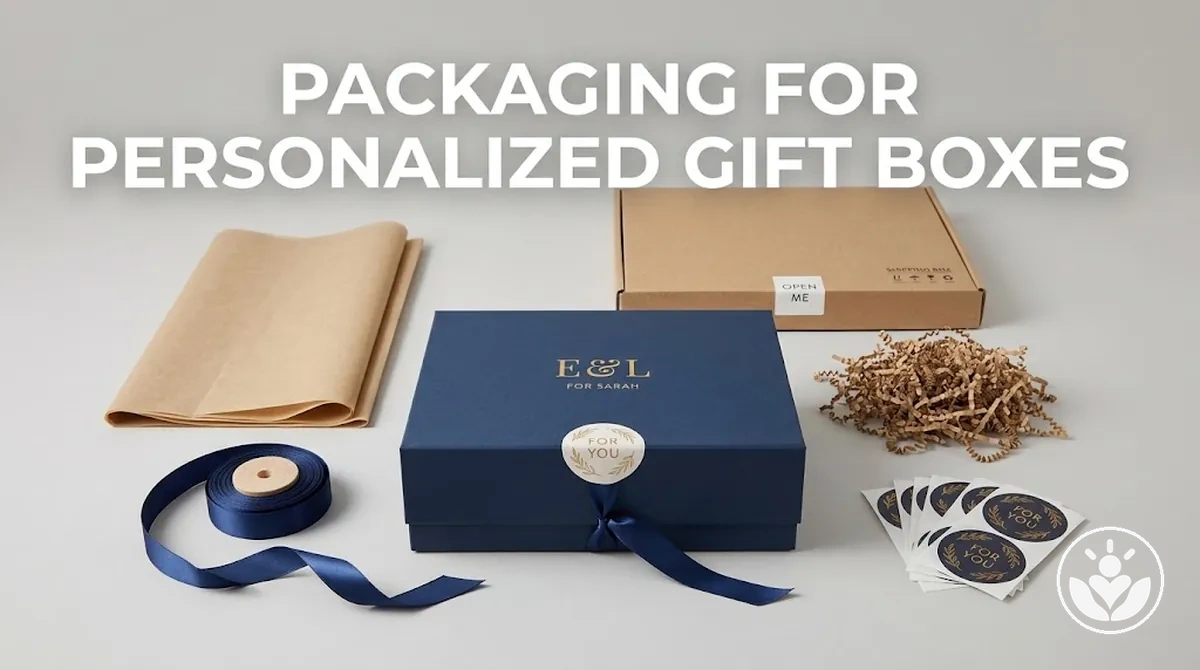
Packaging selection at a glance
Evaluate the box as a combination rather than choosing a material name in isolation. These four dimensions capture the article’s main decision logic.
- Structure
- Ask whether the box must retain its form, fold flat for storage and assembly, or use corrugated construction for greater structural depth during handling or transit.
- Material
- Compare foldability, stiffness, surface and finishing behaviour, wall construction, and end-of-life conditions. A material-family label alone does not define performance.
- Closure
- Match retention, reopenability and assembly needs. Tuck or locking tabs, magnetic closures, lift-off lids, sleeves, drawers and adhesive seals perform these functions differently.
- Use conditions
- Weight, fragility, movement, compression, handling stages and environmental exposure determine how much structural support and internal protection are required.
Decision rule: meet protection and handling requirements first, then refine presentation, opening experience and end-of-life choices. A strong outer box does not replace cushioning or immobilisation when the contents can move or receive impact.
Protection and presentation cannot be inferred from appearance or a single material label. Construction quality, internal support, coatings or laminates, and the relevant recycling system can all change practical performance and end-of-life options.
Table of Contents
How Gift Box Structure, Material and Closure Differ
- Structure
- How the box body is constructed and behaves, such as a rigid form, a folding carton or corrugated construction.
- Material
- What the box or board is made from, such as paperboard, chipboard or corrugated fibreboard.
- Closure
- The mechanism that keeps the package shut and allows it to reopen, such as a tuck tab, lift-off lid or magnetic closure.
Key distinction: these dimensions are related but not interchangeable. One personalized gift box can combine rigid construction, a paper-based board and a magnetic or lift-off closure, with each term describing a different packaging function.
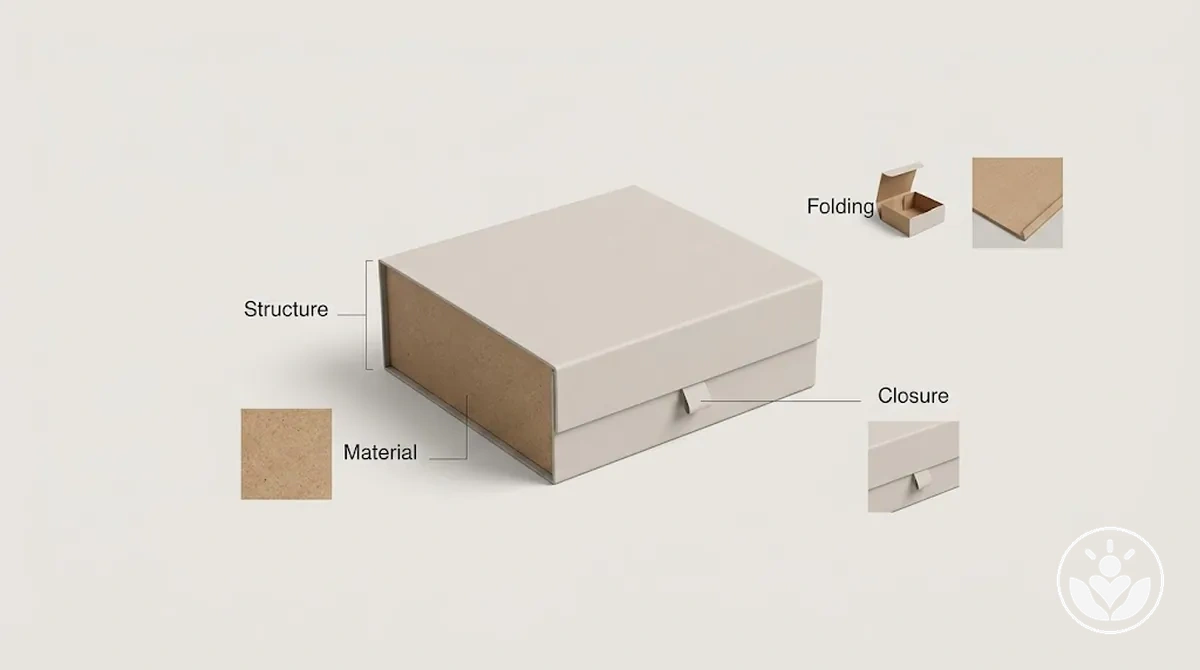
Packaging terminology can vary across manufacturers and markets, and some product names combine construction, material or closure characteristics. When labels overlap, compare the box’s functional role rather than assuming the product name represents only one dimension.
Main Structural Types of Gift Boxes
Gift box structure can be classified by how the box body is formed and whether it retains rigidity before use or collapses for storage and assembly.
The main structural classes are rigid boxes, folding cartons and corrugated boxes, distinguished by construction rather than decorative shape or presentation style.
These three classes separate gift boxes by retained form, folding behaviour and corrugated construction.
Their structural behaviour affects how they are stored and handled before and during use.
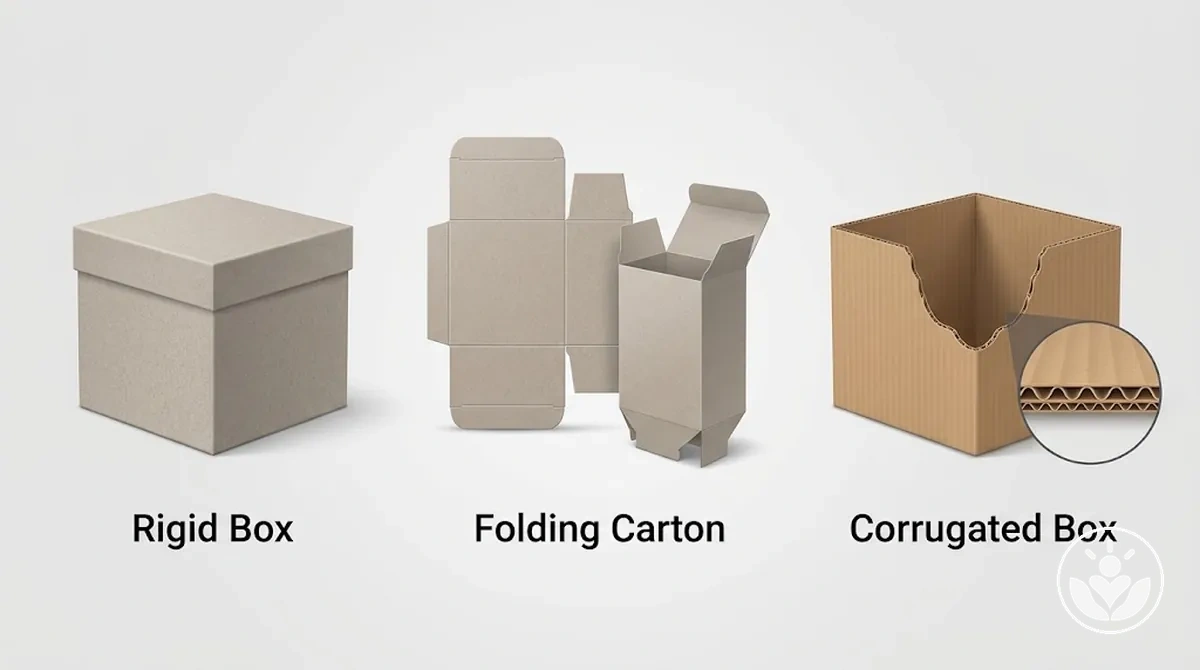
- Rigid boxes: use rigid board construction that retains its formed shape rather than folding flat, so the box occupies its assembled volume during storage and handling.
- Folding cartons: use foldable board construction that can remain flat before assembly, reducing storage volume before the carton is formed for use.
- Corrugated boxes: use corrugated board with a fluted medium between liner layers, creating a structure suited to handling and transit where the board grade, box design and contents provide appropriate support.
Rigidity and collapsibility therefore change the practical storage and handling behaviour of each structural class.
A structure that retains its form requires space in that state, while a folding construction can reduce its storage footprint before assembly; suitability for protection and handling also depends on the specific board, design and contents.
Some rigid-style constructions are designed to collapse or fold for storage, so retained form is a more useful structural criterion than a product label alone.
Decorative shapes or closure details do not create a separate structural class unless they materially change how the box body is constructed or behaves.
Rigid Boxes vs Folding Cartons
Rigid boxes retain their formed shape through relatively stiff board construction, while folding cartons use foldable paperboard construction that can collapse or fold flat before assembly.
This difference in collapsibility changes storage footprint and handling, but crush resistance, weight and suitability also depend on the materials, construction details and intended use.
Applying the same criteria to both structures shows where their practical trade-offs occur.
The comparison covers board construction, collapsibility, weight, storage footprint, crush resistance and presentation feel without treating either structure as universally preferable.
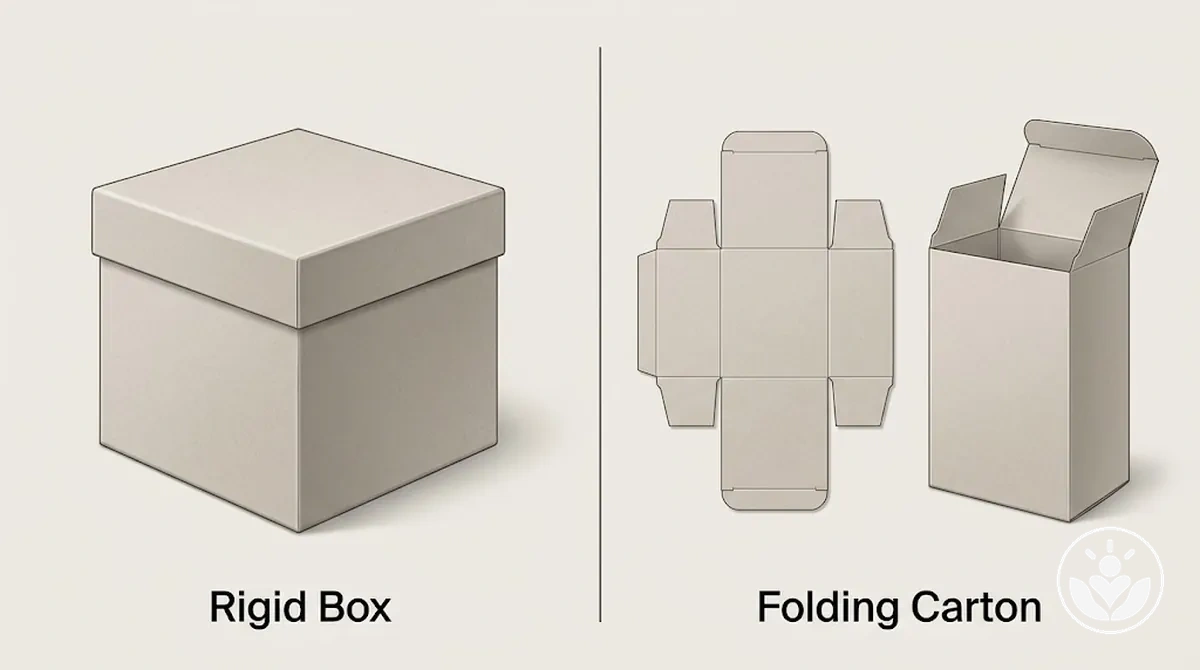
| Criterion | Rigid box | Folding carton |
|---|---|---|
| Board construction | Typically uses relatively stiff board assembled into a form that remains set during normal storage and handling. | Typically uses foldable paperboard with creases or scores that allow the carton to be formed from a flat state. |
| Collapsibility | Conventional rigid construction retains its form, although collapsible rigid designs are an exception. | Usually folds flat before assembly and is formed when required for use. |
| Weight | Relatively stiff board construction can increase packaging weight compared with a comparable lightweight folding carton; actual weight depends on the board and design. | Foldable paperboard construction can reduce packaging weight compared with a comparable rigid box; actual weight depends on the board and design. |
| Storage footprint | A non-collapsible rigid box occupies its formed volume while stored. | A fold-flat carton occupies less storage volume before assembly than after it is formed. |
| Crush resistance | Retained rigidity can increase resistance to deformation under comparable conditions, but crush resistance depends on the board, construction, contents and applied load. | Foldable construction has less retained rigidity than a conventional rigid box, while crush resistance depends on the paperboard, structural design, contents and applied load. |
| Presentation feel | A permanently formed structure provides a shape-retaining presentation, with the overall result also influenced by materials and finishing. | A foldable structure provides a formed presentation after assembly while retaining the practical benefit of flat storage beforehand; materials and finishing also influence the result. |
Collapsible rigid boxes blur the simple retained-form versus fold-flat distinction because they can combine rigid panels with a structure designed to collapse for storage.
A lightweight gift may suit a folding carton where storage efficiency and assembly are priorities, while a presentation-led gift may suit a rigid box where retaining the box form is important; final suitability depends on the contents, board construction and handling conditions.
Corrugated Boxes for Added Structural Strength
Corrugated boxes use corrugated fibreboard made from liner material around a fluted medium.
The fluted layer separates the liners and creates a wall structure that contributes stiffness, crush resistance and resistance to compression during handling.
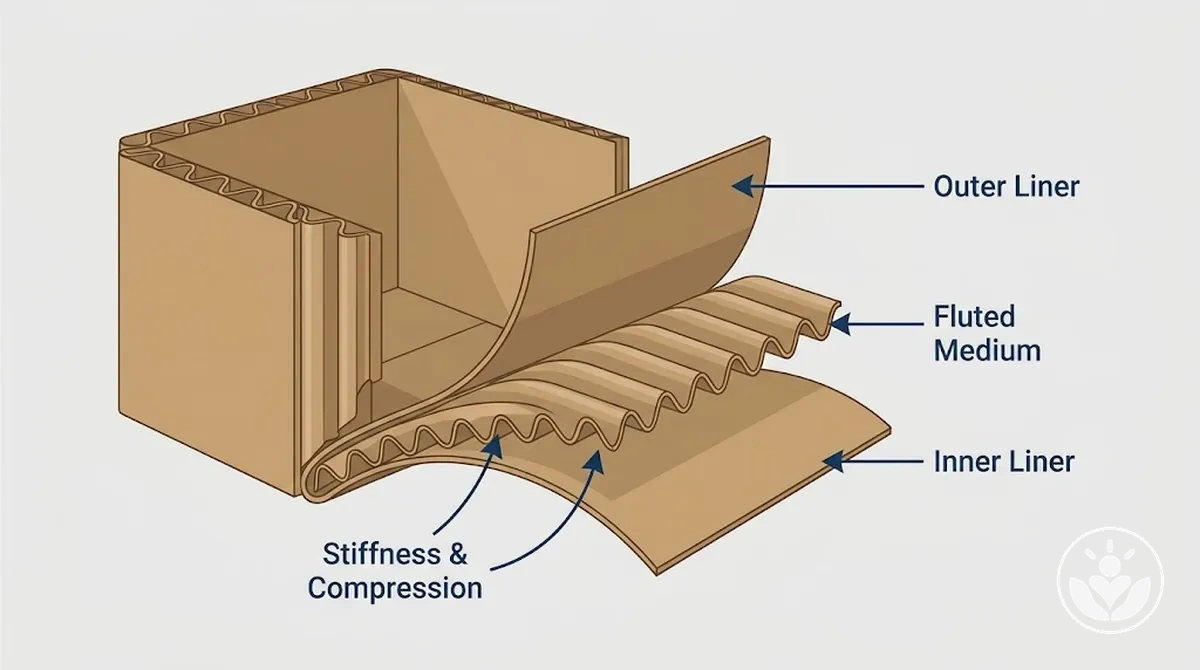
The liner-and-flute construction gives corrugated board structural depth that solid board of similar material does not obtain from a flat layer alone.
Wall construction can therefore contribute to stiffness, compression resistance and the ability to maintain box form during shipping and handling.
Actual performance depends on board grade, wall design, item weight, applied loads and how the contents are supported.
- Wall construction: liners separated by a fluted medium create a corrugated structure with greater structural depth, contributing to stiffness and resistance to bending.
- Compression resistance: the corrugated wall can resist compressive and crushing forces, with the level of resistance determined by the board construction, box design and applied load.
- Handling durability: retained stiffness can help the box maintain its form through handling, but performance changes with board grade, load, environmental conditions and structural design.
- Shipping suitability: corrugated construction can provide useful outer structural strength for gifts exposed to transit and repeated handling when the board grade, box design and contents are appropriately matched.
For example, a fragile or transit-exposed gift may benefit from the additional outer structural strength of a corrugated box when its weight and handling conditions require greater support.
Corrugated construction does not replace appropriate internal cushioning or immobilisation where the contents require protection from movement or impact.
Common Gift Box Materials and Their Properties
Paper-based gift box materials differ in stiffness, surface character, weight, finishing behaviour and structural role.
Paperboard, cardboard, chipboard, kraft board and corrugated fibreboard describe useful material families or common packaging terms, but their exact properties depend on board grade, construction and any surface treatments.
Comparing these materials through the same attributes makes their practical differences clearer.
The table links each material family with its relevant physical or surface characteristics, typical structural role and resulting implication for gift-box construction, protection or presentation.
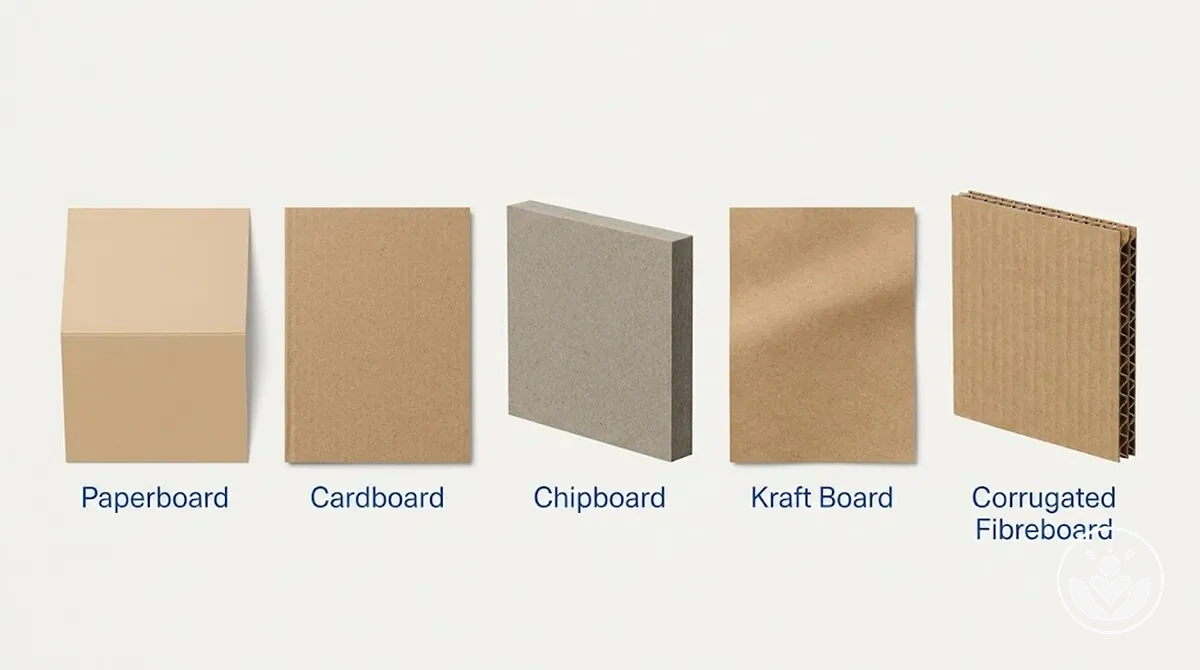
| Material family | Relevant attributes | Typical structural role | Practical implication |
|---|---|---|---|
| Paperboard | Foldable paper-based board with stiffness and a surface that can support printing and finishing, depending on grade and treatment. | Commonly used for folding cartons and other formed lightweight box structures. | Balances foldability with sufficient stiffness for many presentation applications; final surface and structural performance depend on the selected grade and finish. |
| Cardboard | A broad, informal term that can refer to different paper-based boards rather than one standardized technical grade. | Its structural role depends on the specific board meant by the term. | The underlying material specification should be identified before judging stiffness, weight, surface behaviour or suitability. |
| Chipboard | Dense paper-based board that provides retained stiffness and can be covered with a separate printed or decorative surface layer. | Often serves as the structural board or core in rigid box construction. | Supports a shape-retaining box body, while the applied covering can provide the visible presentation surface. |
| Kraft board | Paper-based board with a characteristic fibre-derived surface whose appearance and finishing behaviour depend on grade and surface treatment. | Can form folding or other paper-based packaging structures where its board properties suit the design. | The surface can remain visible or receive printing and finishing, with results affected by the specific substrate and treatment. |
| Corrugated fibreboard | Liner material combined with a fluted medium creates structural depth, stiffness and resistance to compression. | Used where the box requires additional outer structural support for handling or shipping. | Can increase structural strength for transit-exposed packaging, with performance depending on board grade, wall construction, box design, load and content support. |
Moisture response, printability and recyclability cannot be determined from the material-family name alone.
Coatings and laminates can change surface behaviour and moisture response, while the substrate and finish can affect printing results.
Adhesives, coatings, laminates and other combined components may also affect how packaging is processed at end of life.
Recyclability therefore depends on the complete packaging construction and on what the relevant local recycling system accepts.
Paperboard, Cardboard and Chipboard
Paperboard, cardboard and chipboard are related paper-based packaging terms, but they are not exact synonyms: paperboard and chipboard describe more specific board behaviours or uses, while cardboard is often a broader everyday label.
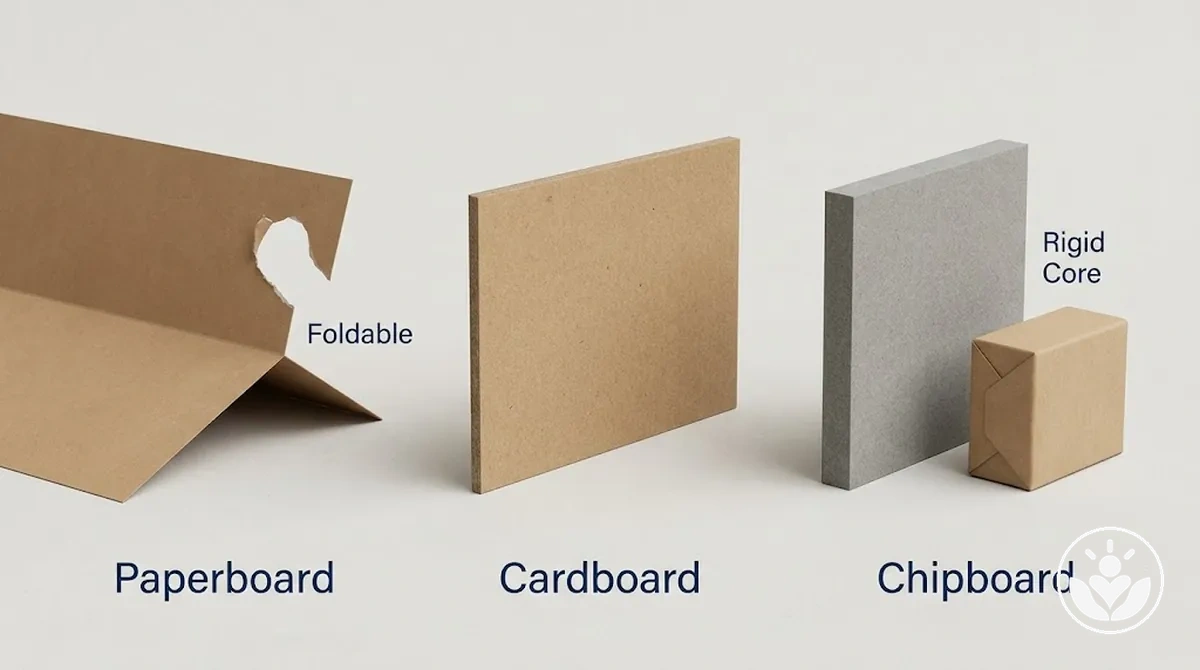
- Paperboard
- Combines stiffness with enough foldability to be creased and formed into cartons; thickness, density and behaviour still depend on the grade.
- Cardboard
- A broad everyday term for heavier paper-based board rather than one precise grade. Identify the actual board construction before assigning a structural role.
- Chipboard
- A dense solid board commonly used as a core in rigid boxes, where retained stiffness matters more than folding the board itself.
Property rule: changes in thickness, density and grade can change stiffness and foldability, so the same broad material family can suit different structural roles.
For example, a foldable carton can use paperboard that creases and folds into its final form, while a paper-wrapped rigid box can use a denser chipboard core that retains its shape beneath the covering.
Both constructions are paper-based, but their presentation and protection characteristics arise partly from different board behaviour rather than from the broad label cardboard alone.
Corrugated Fibreboard
Corrugated fibreboard is a paper-based material made from liner layers bonded around a fluted medium.
- Structural form
- The fluted medium separates the liners, creating structural depth that behaves differently from a flat solid board.
- Mechanical behaviour
- The wall construction contributes stiffness and compression resistance while remaining relatively lightweight for its structural role.
- Performance depends on
- Board grade, flute or wall configuration, applied load and the final box design; there is no single strength level implied by the material name.
- Surface and finishing
- The liner can support printing or finishing, but surface quality and finishing behaviour depend on the liner grade and any coatings.
Compared with solid paperboard or chipboard, corrugated material gains part of its mechanical behaviour from the space and geometry created by the fluted medium rather than from a solid board body alone.
This difference can make corrugated fibreboard more suitable where compression or stacking forces are important, while solid board may be preferred where a compact, smooth or rigid presentation surface is the primary requirement.
Kraft vs Cardboard: What the Terms Actually Describe
Kraft
Describes a kraft paper-making or material context and can apply to kraft paper or kraft board.
Cardboard
Is a broad everyday category for heavier paper-based board and does not identify one precise board grade.
They can overlap: a cardboard gift box may use kraft material and can therefore be described as kraft cardboard. The terms are not mutually exclusive.
Material selection should therefore consider the actual board construction, strength requirements, coatings and recyclability conditions instead of treating either label as a universal performance grade.
Gift Box Closure Types and Their Functional Differences
Gift box closure mechanisms differ in how they provide retention for a lid or flap and how readily the package can be reopened.
A tuck tab or locking tab, magnetic closure, lift-off lid, sleeve, drawer or adhesive seal can therefore affect reopenability, assembly and handling without determining the overall box structure.
The functional comparison centres on retention, reopenability, assembly effort and behaviour during handling.
Each closure mechanism provides these functions differently, and its practical performance also depends on the surrounding box construction and how the package is handled.
| Closure mechanism | Retention and reopenability | Assembly and handling implication |
|---|---|---|
| Tuck tab or locking tab | A tab engages with a flap, slot or panel to retain the closure and can usually be disengaged for reopening. | Requires correct folding and engagement during assembly; retention depends on tab geometry, board condition and handling. |
| Magnetic closure | Magnets retain closing panels while allowing repeated opening without breaking the closure mechanism. | Supports convenient reopening, but retention depends on magnet placement, construction and the forces applied during handling. |
| Lift-off lid | A separate lid is retained by its fit over the box body and remains readily removable for reopening. | Requires little closing action after assembly; retention during handling depends on fit, dimensions and construction. |
| Sleeve or drawer | A sleeve retains an inner tray or drawer through the fitted relationship between the components while allowing repeated sliding access. | Reopening is straightforward, but smooth operation and retention depend on dimensional fit, material and construction. |
| Ribbon or tie closure | A tied element holds parts of the package together and can normally be untied for repeated access. | Adds a manual tying step and may provide variable retention according to how the tie is secured and handled. |
| Adhesive seal | An adhesive seal bonds closing surfaces or holds a flap closed; reopening commonly requires separating or breaking the sealed area. | Can reduce reopenability compared with non-adhesive mechanisms, while retention depends on the adhesive, substrate, bonded area and handling conditions. |
No closure mechanism alone makes a gift box suitable for shipping or every handling condition.
A magnetic closure or lift-off lid can prioritise convenient reopenability, while a tuck tab can combine closure with carton assembly and an adhesive seal can trade easier repeated access for bonded retention.
The appropriate balance depends on the required retention, expected reuse, assembly effort and handling conditions, together with the box structure and contents.
Matching Packaging to Protection, Handling and Shipping Needs
Packaging suitability should be matched to item weight, fragility and expected handling conditions before appearance is considered.
Greater exposure to impact, compression, repeated handling or environmental conditions can make rigidity, closure retention and protective material properties more relevant, but no single criterion determines suitability.
The criteria interact: item condition establishes the protection need, while handling and shipping exposure influence the structural attributes required to meet it.
Box dimensions also affect support and movement, so choose the right gift box size as part of the suitability assessment rather than treating size as a separate appearance choice.
- Item weight and fragility: Assess how heavy the contents are and whether they are brittle, delicate or easily marked. Higher weight or fragility makes adequate material strength, rigidity and internal support more important for limiting movement and deformation.
- Handling intensity: Consider whether the gift will be hand-delivered or pass through repeated loading, sorting and transfer stages. More handling increases the relevance of a structure that maintains its form and keeps the contents supported.
- Impact exposure: Consider whether drops, knocks or sudden movement are plausible during handling. Where impact exposure is greater, the box structure and internal cushioning or support need to work together to reduce direct movement and contact.
- Compression exposure: Assess whether other packages or objects may place load on the box during storage or transit. Greater compression exposure makes structural rigidity and resistance to deformation more relevant.
- Shipping distance and handling stages: A longer shipping route does not by itself define the required box, but additional transfer and handling stages can increase exposure to movement, impact and compression. Packaging requirements should therefore reflect the expected handling sequence rather than distance alone.
- Box rigidity: Evaluate whether the structure remains sufficiently stable for the item's weight, geometry and expected handling. Greater rigidity may suit conditions where maintaining box shape and supporting the contents are important.
- Closure retention: Assess whether the closure can keep the lid, flap, sleeve or drawer in its intended position under the expected movement and handling. The required retention depends on the closure mechanism, box construction and contents rather than the closure type alone.
- Environmental exposure: Consider plausible moisture, scuffing or other surface exposure during storage, delivery and shipping. Material, coating and surface-finish choices become more relevant when those conditions could affect the package or its contents.
Internal arrangement interacts with box structure because empty space, item position and supporting materials can change how movement and loads are transferred within the package.
These variables should be considered when evaluating suitability, while the detailed process for how to arrange items inside the packaging remains a separate task.
A lightweight, non-fragile gift delivered by hand may suit a lighter structure when handling exposure is limited, whereas a brittle item moving through multiple parcel-handling stages may require greater rigidity, stronger closure retention and more internal support.
A heavier gift can also require a more structurally capable box even when it is not especially fragile because its item weight places greater demands on the base, walls and closure.
Suitability therefore changes with the combined item, handling, shipping and environmental conditions rather than with appearance or one packaging attribute alone.
Packaging Structures and Materials for Fragile Gifts
Fragile gifts need packaging with enough rigidity and crush resistance to limit crushing and deformation under the expected handling conditions.
The appropriate structure depends on item weight, brittleness, shape and transit exposure, so a delicate lightweight item and a heavier breakable item may require different structural protection.
Fragility changes the structural requirement according to how the item and package are likely to behave during handling:
- Lightweight delicate items: When item weight is low but the surface or form is easily damaged, a structure with sufficient rigidity to resist ordinary deformation may suit the protection need while internal support limits movement.
- Heavier breakables: Greater item weight can place more demand on the base and walls, making rigidity and resistance to deformation more important; rigid board may suit some gift-box constructions when the box design and item shape provide adequate support.
- Transit-exposed fragile gifts: Repeated handling can increase exposure to compression, knocks and movement, making crush resistance and structural stability more relevant; corrugated construction may suit conditions where resistance to compression and handling loads is required.
- Awkward or concentrated shapes: When the shape creates uneven contact or load points, the outer structure needs enough rigidity for those conditions, while internal support must control how the item contacts and moves within the box.
Outer structure and internal support perform different protection functions: a rigid or corrugated outer box can resist external deformation, but it does not by itself provide immobilisation or cushioning for a brittle item against movement and impact.
For those internal protection functions, gift box fillers and cushioning should be considered separately from the structural strength of the outer package.
Packaging Structures Suitable for Shipping and Delivery
A presentation box placed inside separate shipping packaging serves a different role from a gift box used directly as the shipping-ready outer package.
Once the gift box itself is exposed to transit handling, outer-wall strength, crush resistance, closure retention and surface durability become more important because the package must tolerate handling without relying on another protective container.
Direct parcel exposure also increases the relevance of scuff exposure and secondary protection.
Corrugated construction can provide additional structural strength when the gift box functions as the outer shipping package, but suitability still depends on board grade, box design, closure construction, contents and expected handling.
- Presentation box inside outer packaging: The presentation box is partly shielded from direct transit handling by the separate outer package, so its surface, closure and walls do not carry the full shipping load. The outer package provides the main resistance to compression, scuffing and handling exposure, while the presentation box primarily supports the gift and presentation function.
- Gift box used as the shipping-ready outer package: The gift box is directly exposed to parcel handling, so wall strength, crush resistance, closure retention and surface durability become more important. Corrugated material or another suitably strong construction may be appropriate where the outer package must resist compression and handling loads without secondary structural protection.
A strong outer structure does not by itself provide movement control for the contents inside the package.
Internal support and positioning remain separate requirements, so the packaging should also keep contents secure when movement during delivery could create contact, shifting or impact within the box.
Sustainability Factors in Gift Box Packaging Materials
Sustainability factors in gift box materials should be evaluated across material inputs, resource use and end-of-life conditions rather than inferred from colour or a single material label.
A kraft appearance alone does not establish lower environmental impact, because recycled content, fibre sourcing, material reduction, reusability and recyclability can differ between packaging constructions.
A consistent assessment considers what materials and resources enter the package and what happens to the complete construction after use.
The table links each material feature to the resource or end-of-life condition that affects its practical sustainability implication.
| Material feature | Resource or end-of-life condition | Practical implication |
|---|---|---|
| Recycled content | The proportion and type of recovered fibre or other recycled material used in the packaging construction. | May reduce demand for virgin material, while the practical effect depends on the material composition and performance required from the finished box. |
| Fibre sourcing | The origin and management context of virgin fibre used where recycled fibre does not make up the complete material input. | Provides a resource-use criterion that should be evaluated separately from the colour or appearance of the paper-based board. |
| Material reduction | The amount of material required to provide the necessary structural and protective function. | Can reduce material use when a lighter or simpler construction still meets the required packaging function without shifting the burden to additional components. |
| Reusability | The box remains sufficiently durable and functional for repeated use under its intended conditions. | Repeated use may extend the useful life of the package, but reusability depends on construction, durability and whether the box is actually retained and reused. |
| Recyclability | The complete packaging construction is compatible with collection, sorting and processing in the relevant local recycling system. | A material may be recyclable in principle without being accepted or effectively processed in the user's local system. |
| Coatings and laminates | Surface layers remain attached to the underlying board unless they can be separated during processing. | Coatings and laminates can affect end-of-life processing, so their effect should be assessed as part of the complete material construction rather than the paper substrate alone. |
| Adhesives, magnets and windows | Attached components can create a multi-material construction or require separation before particular materials can enter suitable recycling streams. | These components can affect recyclability or separation options depending on their materials, attachment method and the capabilities of the local recycling system. |
Recyclability depends on both packaging construction and local collection and processing conditions, not simply on whether the main substrate is paper-based.
Coatings, laminates, adhesives, magnets and windows can change end-of-life options when they introduce materials that are not compatible with the same processing route.
For example, a simple mono-material paper-based box may present fewer material-separation requirements than a multi-material decorated box containing a laminate, window, magnet or attached decorative component, although actual recyclability still depends on the local recycling system.
Sustainability claims should therefore be qualified by the complete construction, expected reuse and available end-of-life pathway.