
Planning Personalized Corporate Gift Boxes
Plan personalized corporate gift boxes by defining the purpose, occasion, and recipient first; then verify policy and recipient restrictions, set quantity, budget, and the required arrival date, separate recipient-level personalization from stable brand standards, choose suitable contents, specify protective presentation, and use a repeatable verification and distribution workflow. The right plan is context-dependent rather than universal: recipient fit, organizational rules, scale, timing, and delivery conditions determine which choices are suitable.
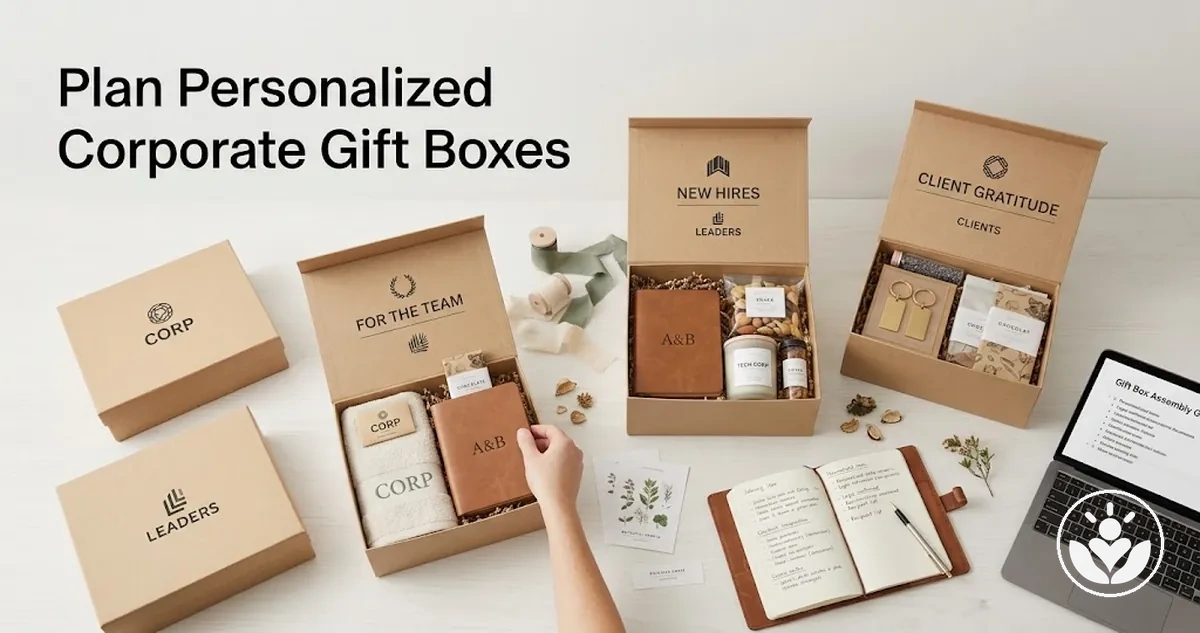
Planning sequence
Build the corporate gift-box plan in seven linked decisions
Resolve each stage before the next one is locked. Later choices inherit the constraints established by the recipient, policy, scale, timing, and delivery context.
-
Purpose, occasion, and recipientDefine why the gift is being given, the business moment, and who will receive it.
-
Policy and acceptanceClassify relevant conditions as allowed, limited, approval-required, or still uncertain before finalizing the gift.
-
Quantity, budget, and arrival dateSet recipient count, total and per-recipient budget boundaries, then work backward from the required arrival date.
-
Personalization and brand rulesSpecify which recipient details may vary and which brand cues must remain consistent across the program.
-
ContentsApprove items only when they fit the recipient, occasion, restrictions, handling conditions, and delivery method.
-
Packaging and presentationMeet protection, fit, handling, message, and brand-presentation requirements at the same time.
-
Assembly, verification, and distributionMatch each box to the approved specification and recipient data, hold exceptions, and release only verified boxes.
Control rule: if a policy condition, restriction, address, personalization value, or required specification is unresolved, keep the affected box at that stage until it is verified.
Table of Contents
Define the Corporate Gifting Purpose, Occasion, and Recipient Group
Four variables that set the planning direction
- Purpose
- Whether the gift marks appreciation, recognition, onboarding, a milestone, an event, or another relationship moment.
- Occasion
- The business context and timing that shape tone, relevance, and delivery requirements.
- Recipient group
- Clients, employees, or another defined group, together with the relationship context that affects suitability.
- Combined effect
- These variables narrow the suitable tone, personalization approach, contents, and timing before detailed choices are made.
The same gift-box concept may require a different tone, personalization approach, contents, or timing when its purpose or recipients change.
This corporate context is more specific than the broader planning considerations for personalized gift boxes because the gifting objective and business relationship affect suitability.

For example, an onboarding box for employees may call for a different message and delivery timing than a client box marking a business milestone.
Separate treatment is useful when purpose, occasion, relationship context, or practical requirements materially change the planning implication, rather than simply because recipients carry different labels.
Planning Gift Boxes for Clients
For an established client, an appreciation gift and a project milestone can call for different levels of personalization and professional tone.
The relationship stage and occasion should determine whether client gift boxes feel understated, more specifically tailored, or appropriate for the business moment.
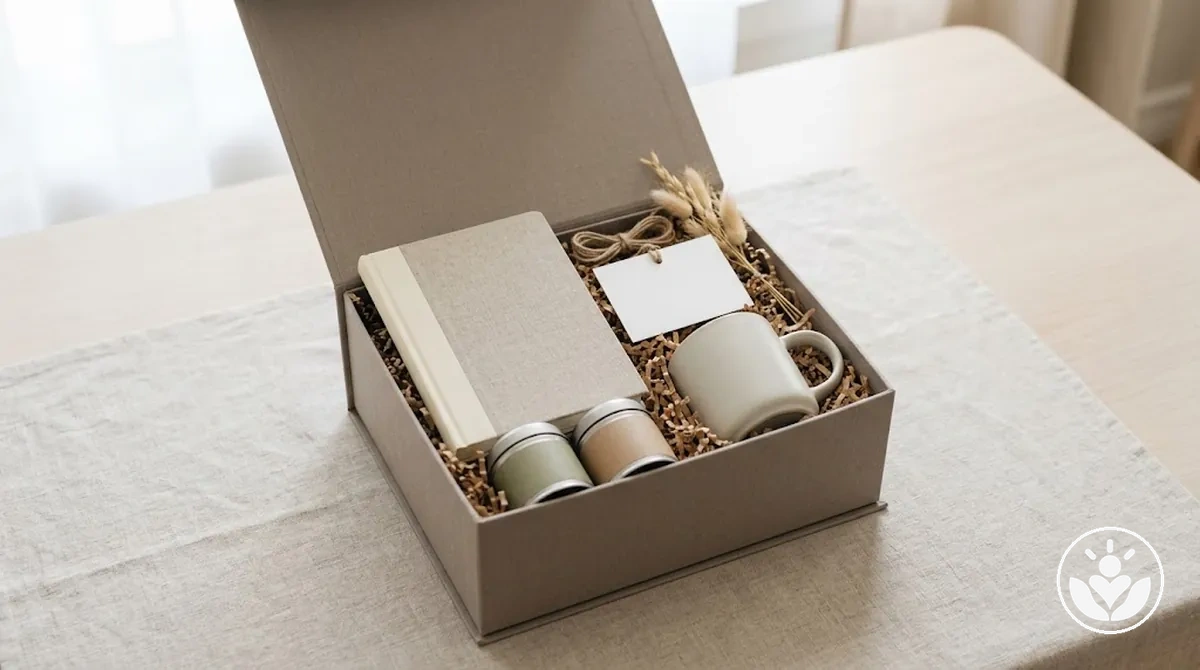
Recipient preferences should guide personalization where they are known, while branding should remain restrained enough to suit the client relationship and occasion.
Acceptance rules may also limit what clients can receive, so those constraints should be checked before finalizing the gift.
Client gifting choices should match the relationship stage, occasion, recipient preferences, and acceptance constraints rather than a fixed prestige level.
Planning Gift Boxes for Employees
For employee gift boxes, an onboarding occasion may call for a welcoming professional tone and consistent core presentation across new employees.
Recognition, team appreciation, or a milestone may call for more recipient-specific personalization while retaining relevant consistency standards.
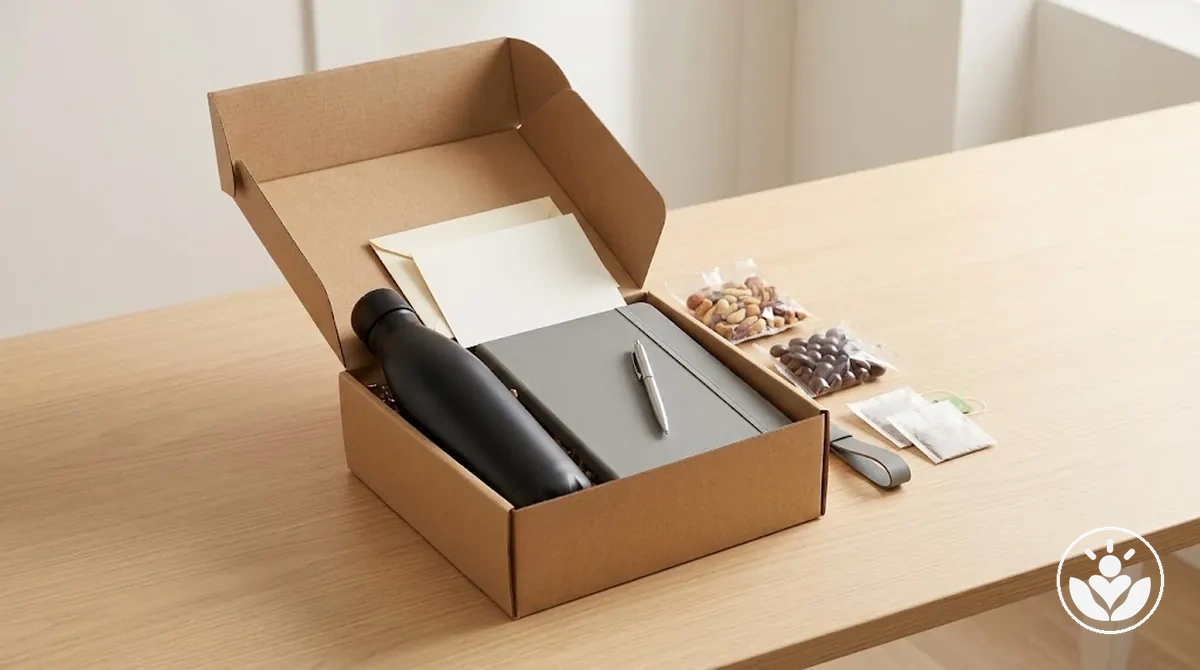
Recipient preferences should guide personal relevance, while dietary considerations and cultural considerations may require suitable variations in contents.
Remote delivery changes implementation by requiring delivery-ready presentation and timing appropriate to each destination, while internal policy may set further conditions.
Consistency does not require identical treatment when recipient conditions materially differ.
Check Corporate Gift Policies, Acceptance Rules, and Recipient Restrictions
Corporate gift rules and recipient restrictions should be checked before finalizing a gift box.
An organizational policy may allow, limit, or require approval for gifting in particular situations, while recipient-company acceptance rules may restrict what certain recipients can accept.

Giver-side organizational policy determines the internal conditions that apply to the planned gift, including any required approval.
Recipient-organization acceptance rules apply separately and may limit gifts for particular roles or situations where conflicts of interest are a concern.
Recipient restrictions concern the individual and may include dietary restrictions, cultural considerations, or other conditions affecting suitability.
Use these checks to establish whether each relevant condition is allowed, limited, or uncertain before proceeding:
- Giver-side policy: Confirm whether the organizational policy allows the planned gift or limits it under the applicable occasion or recipient context.
- Recipient-company acceptance rules: Confirm whether the recipient's organization allows the gift or applies acceptance conditions that limit it.
- Restricted roles or contexts: Check whether the recipient's role or situation may restrict gifting because of applicable conflicts-of-interest rules or organizational requirements.
- Dietary restrictions: Confirm whether individual dietary requirements limit particular contents and require suitable substitutions.
- Cultural considerations: Check whether known cultural considerations make particular contents, messages, or presentation choices unsuitable for the recipient.
- Approval: Check whether the giver's organization or another applicable organizational process requires approval before the gift is finalized or distributed.
- Uncertain conditions: Treat an unclear rule as uncertain rather than assuming the gift is allowed, and verify it with the relevant organization before finalizing the gift box.
Personal preference and organizational permission are separate checks: a recipient may prefer an item that their organization limits, or organizational rules may allow an item that is unsuitable for that individual.
When an applicable policy, acceptance condition, restriction, or approval requirement remains uncertain, confirm it with the relevant organization rather than guessing.
Set Quantity, Budget, and Delivery Timeline
Set the recipient count, budget, and required arrival date together before locking personalization or execution decisions.
Quantity establishes the scale of the plan, while the total budget and per-recipient budget set its spending boundaries.
The required arrival date is the fixed endpoint for the schedule; lead time is the time available to complete personalization, assembly, and dispatch.
Do not assume a universal price or lead time. Define the workable budget and schedule from the actual quantity, personalization requirements, preparation stages, and delivery conditions.
Quantity, budget, and lead time constrain one another: greater volume can increase operational complexity, a tighter budget can limit feasible personalization, and a nearer arrival date leaves less time for correction and contingency.
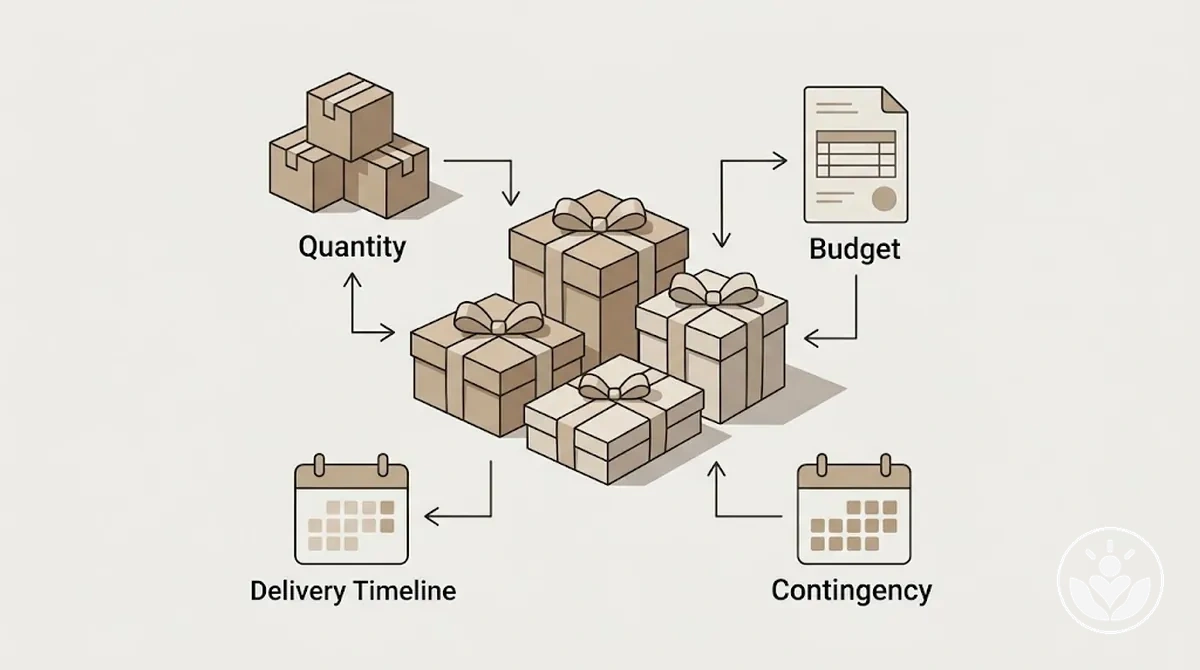
Separate fixed costs from variable costs so changes in recipient count can be assessed against both the total budget and per-recipient budget.
Place these constraints within the broader gift box planning framework, then allow contingency for plausible address changes, personalization corrections, or late additions.
The workable buffer should reflect the actual project and delivery conditions rather than a fixed universal lead time.
- Establish recipient count: Confirm the quantity required so the scale and operational complexity are known before later decisions.
- Set budget boundaries: Define the total budget and per-recipient budget, then distinguish fixed costs from costs that change with quantity.
- Define the required arrival date: Set when recipients need the boxes so the available delivery timeline has a clear endpoint.
- Work backward through lead time: Allow time for personalization, assembly, and dispatch without assuming a universal duration for any stage.
- Add contingency: Allow a workable buffer for plausible address changes, personalization corrections, late additions, or other project-specific timing risks.
Set Personalization and Brand Consistency Criteria
Define personalization and brand consistency together so recipient-specific details can vary while repeatable brand standards remain stable.
Personalization may change the recipient name, message, or selected personal touches; brand consistency should define which logo use, brand colours, tone, packaging accents, and visual standards remain consistent across the gift-box program.
Separate variable recipient details from stable company-level brand cues. This keeps individual relevance distinct from brand expression while giving multiple boxes a repeatable presentation standard.
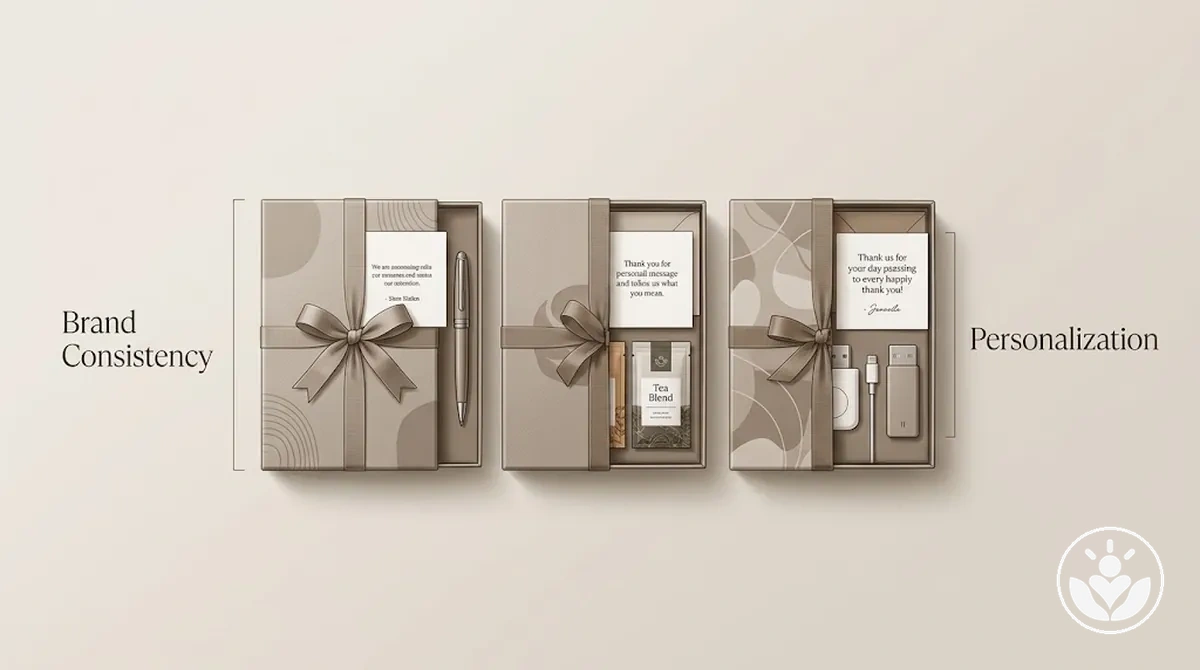
- Recipient name: May vary for each recipient when individual identification is appropriate to the gifting context.
- Message: May vary according to the recipient and occasion while remaining consistent with the intended professional tone.
- Curated content choices: May vary when known recipient preferences or restrictions make different contents more relevant.
- Logo: Keep its use consistent where a brand cue is needed, while allowing restrained visibility that does not dominate personalization.
- Brand colours: Keep selected colour cues consistent across boxes where they support a coherent brand identity.
- Tone: Maintain an appropriate company-level tone while allowing the message itself to reflect the recipient and occasion.
- Packaging accents and visual standards: Keep repeatable presentation cues consistent where scale requires a coherent execution standard.
For example, coordinated packaging accents and restrained logo use can provide subtle brand coherence while each recipient receives a different name or message.
Oversized branding or promotional-style messaging can shift attention away from the recipient-focused purpose.
Brand recognition should support, not replace, recipient relevance.
Balance Recipient-Level Personalization With Company Branding
How the emphasis changes
Recipient-level personalization
Its role is message relevance through the recipient name, a specific message, or other relevant personal touches. It can carry more weight when the occasion is highly individual.
Company branding
Its role is identity and consistency through restrained logo use, brand colours, tone, or packaging cues. Shared brand cues can carry more weight when many boxes belong to one corporate occasion.
Decision rule: the two elements serve different purposes. Branding should support the recipient-focused presentation rather than become its main purpose, and the balance should follow the recipient context and occasion rather than a fixed branding level.
Standardize Personalized Details Across Multiple Gift Boxes
Standardize personalized details by controlling recipient data against an approved source and fixed brand standards before production begins.
Define which name variables, message variables, and brand assets may change, and which elements must remain consistent.
Version control should identify the approved personalization data and assets used for each batch.
This keeps variation intentional and gives quality control a clear basis for checking each box.
- Prepare approved recipient data: Use one approved source for recipient names, message variables, and other permitted personalization fields.
- Define allowed variation: Specify which personalized details may change by recipient and which values must follow one approved standard.
- Control brand assets: Use the approved version of logos, colour references, message formats, or other relevant brand assets for the batch.
- Apply version control: Record which recipient data and approved assets belong to the current batch so outdated versions are not mixed into production.
- Complete recipient-to-box matching: Match each set of personalized details to the intended recipient before the box is released.
- Run final verification: Check the name, message, approved assets, and recipient-to-box matching as the final quality-control step before release.
A small batch may need only a simple controlled record, while a larger batch may require stricter version control and repeatable verification to manage more variable recipient data.
The required process rigor therefore increases with batch size and the number of personalized details being handled.
Final recipient-to-box verification should remain the last control point before release.
Choose Contents That Fit the Recipient, Occasion, and Company Context
Corporate gift-box contents should be selected for recipient suitability and occasion fit before novelty or price.
Each content candidate should have a clear use or relevance within the gifting context rather than being included for popularity alone.
Usefulness and coherence help determine whether individual items belong together and suit the intended company context.
No item category is appropriate for every recipient or occasion.
Treat restrictions and delivery conditions as inclusion criteria, not afterthoughts: known dietary requirements or cultural considerations may require substitution, while fragility, shelf life, or shipping incompatibility can make an otherwise relevant item unsuitable for the planned handling, destination, or delivery method.
- Recipient suitability: Include an item when its purpose or characteristics fit known recipient preferences and relevant needs.
- Occasion fit: Include contents whose tone and usefulness suit the specific corporate gifting occasion and company context.
- Coherence: Prefer items that contribute to a coordinated purpose or theme rather than creating an unrelated collection.
- Dietary needs: Exclude or substitute food and drink items when known dietary requirements make the candidate unsuitable.
- Cultural suitability: Exclude or reconsider an item when known cultural considerations make its contents, symbolism, or presentation unsuitable.
- Fragility and shelf life: Reconsider items when their physical durability or usable life does not suit the planned handling and delivery conditions.
- Shipping practicality: Include an item only when its size, form, and handling needs are compatible with the intended delivery conditions.
For example, a food item may suit one recipient but require substitution when known dietary needs make it unsuitable; similarly, a fragile item may fit a local presentation but not a delivery context where its handling requirements cannot be met.
These examples illustrate selection conditions rather than a catalogue of recommended products.
For detailed item-level options, choose appropriate gift box contents according to the recipient and gifting context.
Set Packaging and Presentation Requirements for Corporate Gifting
Corporate gift-box packaging requirements must address protection, handling, delivery, and professional presentation together.
Packaging should fit the contents, provide appropriate structural protection, and remain suitable for the intended delivery method.
Presentation requirements should also support the intended message and brand coherence without compromising functional performance.
A polished appearance does not by itself establish that packaging can withstand its handling conditions.
Two requirements that must be satisfied together
Functional performance
- Fit: item size and arrangement must support stable placement and appropriate closure. Where dimensions become the main constraint, choose the right box size according to the contents and intended fit.
- Structural protection: protection should reflect item weight, fragility, and expected handling.
- Movement control: items that can shift during transport need restraint appropriate to their form and fragility.
- Transport resilience: packaging must suit the expected delivery route, handling, and storage conditions.
Presentation
- Message presentation: the message should remain visible, legible, and appropriate to the occasion.
- Brand coherence: brand cues should remain consistent without displacing recipient-focused personalization.
- Unboxing context: the opening experience should suit the recipient, occasion, and delivery context while remaining compatible with protection.
Boundary: protection and presentation are separate but simultaneous requirements. A presentation-first choice is unsuitable if it weakens functional performance; a transport-first choice may need refinement if it obscures the intended message or professional presentation.
These criteria define what the packaging must accomplish before a packaging type or material is selected.
When planning reaches that boundary, understand packaging types and materials in relation to the requirements already established.
Plan Assembly, Quality Checks, and Distribution as a Repeatable Workflow
Convert the approved gift-box specification into a repeatable workflow with defined stages and a verification point at each handoff. Each stage should begin with its required input and proceed only after the relevant check is complete.
Keep recipient data, personalization, contents, packaging integrity, label matching, and address matching controlled throughout the process. Quality control belongs across staging, assembly, verification, matching, and release rather than only at the final inspection.
If a missing item, personalization error, damaged package, or address change affects a box, hold that handoff until the issue is corrected and the affected verification is repeated. Batch assembly can support repeatability, but recipient-specific checks still apply before release for distribution.
- Freeze the specification: Confirm the approved contents, personalization rules, packaging requirements, and distribution inputs; hold staging if any required specification is unresolved.
- Prepare recipient data: Prepare approved recipient data, personalization values, labels, and addresses; verify each required field before handing the data to assembly.
- Stage contents: Stage the specified contents for assembly and verify their availability and condition; hold any affected box when an item is missing or damaged.
- Assemble the batch: Assemble gift boxes in a repeatable sequence where batch processing is appropriate; verify each box against the approved specification before handoff.
- Verify contents and personalization: Check the contents, recipient name, message, and other personalized details against recipient data; correct any mismatch before proceeding.
- Check packaging integrity: Verify closure, presentation, and packaging integrity; hold any box with visible damage or another unresolved packaging issue.
- Match labels and addresses: Match each completed box to its intended recipient, label, and address; resolve any address change before distribution.
- Release for distribution: Release only boxes with verified contents, personalization, packaging integrity, label matching, and address matching.
Exception handling should return the affected box to the relevant workflow stage rather than bypassing its quality check.
After correcting a missing item, personalization error, damaged package, or address change, repeat the affected verification before release for distribution.
Avoid Common Corporate Gift Box Planning Mistakes
Corporate gift-box planning mistakes become consequential when they reduce recipient fit or create avoidable policy, suitability, presentation, or timing problems.
Common failure patterns include generic choices made without recipient context, unsuitable contents when restrictions are missed, branding or presentation that displaces the recipient-focused purpose, and schedules that leave too little time for personalization, correction, assembly, or distribution.
The most useful way to evaluate each mistake is by its likely consequence, an observable recognition cue, and a corrective direction. The table connects recurring errors with the earlier planning decision that can prevent or correct them.
| Planning Mistake | Likely Consequence | Recognition Cue | Corrective Direction |
|---|---|---|---|
| Choosing gifts without recipient fit | The box can feel generic or contain items with limited relevance to the intended recipient. | Contents were selected without using known recipient preferences, needs, or relationship context. | Recheck recipient fit and retain items with a clear reason for inclusion. |
| Overlooking dietary considerations | Food or drink contents may be unsuitable when known dietary restrictions apply. | No dietary information or substitution decision was checked before contents were finalized. | Verify known dietary considerations and substitute unsuitable contents before assembly. |
| Overlooking cultural considerations | Particular contents, messages, or presentation choices may be unsuitable in the relevant recipient context. | Cultural suitability was not considered despite known recipient or occasion-specific conditions. | Review known cultural considerations and adjust affected contents, messaging, or presentation. |
| Using over-branding | Prominent company branding can make the presentation feel more promotional than recipient-focused in some gifting contexts. | Logos, brand messages, or company cues dominate the personalized message or recipient-facing presentation. | Reduce branding prominence and retain only the brand cues needed for coherent company presentation. |
| Prioritizing low cost over suitability or quality | Cost-led choices can increase the risk of low quality, reduced practicality, or weaker recipient relevance when suitability becomes secondary. | An item remains in the plan mainly because of price despite weaker fit, usefulness, or condition. | Evaluate cost within the approved budget alongside recipient suitability, practicality, and required quality. |
| Ignoring presentation requirements | The box may meet basic content needs while failing to provide the intended professional presentation or adequate delivery readiness. | Packaging, message placement, closure, or presentation was not checked against the delivery and gifting context. | Define functional and presentation requirements before finalizing packaging and assembly. |
| Missing policy constraints | The planned gift may require changes or approval when giver-side policy or recipient-company acceptance rules apply. | No applicable policy, acceptance rule, recipient restriction, or approval requirement was checked before finalization. | Verify relevant policy constraints and resolve required approvals or restrictions before proceeding. |
| Planning too late | Limited lead time can reduce the time available for personalization, correction, assembly, and distribution preparation. | The required arrival date is set without sufficient time for the planned preparation stages and plausible corrections. | Work backward from the required arrival date and allow project-specific time for preparation, verification, and contingency. |
These mistakes are most effectively prevented by resolving recipient, policy, contents, presentation, and timing decisions before execution begins.
A context-dependent choice becomes a planning mistake when its conditions conflict with the requirements of the specific gift.